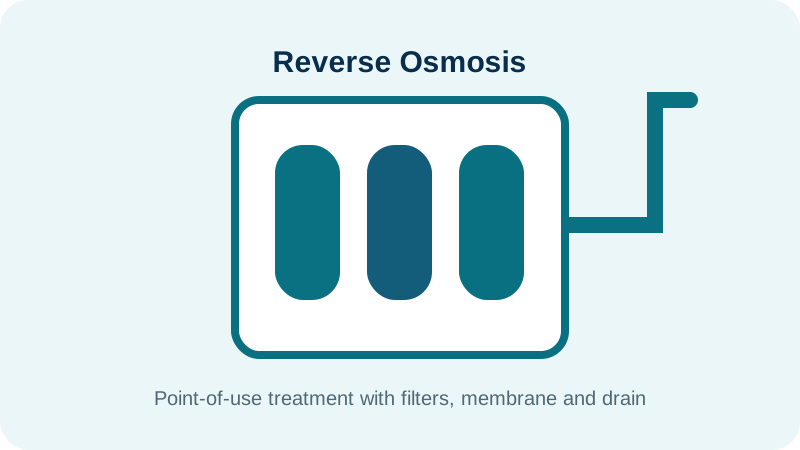
Reverse osmosis usually treats a small drinking-water stream at one location, while a whole-house filter treats incoming water before it reaches most fixtures. Neither category is automatically “better.” The correct choice depends on where treatment is needed, the exact water goal, service-flow requirements and verified claims for the selected model.
A Houston homeowner concerned about taste at every shower and faucet is asking a different question from someone who wants a certified reduction claim at the kitchen sink. Start with that distinction before comparing equipment packages.
Point-of-use versus point-of-entry
Most residential reverse osmosis systems are point-of-use units. They use pretreatment and a membrane to produce water slowly, store it in a tank and dispense it through a dedicated faucet. The design can be practical for drinking and cooking without treating water used for toilets, irrigation, showers or laundry.
Whole-house water filtration is point-of-entry treatment. Depending on the exact media and model, it may target sediment, a specified taste or odor condition, or another documented goal throughout the home. It must pass enough water for simultaneous fixture demand without unacceptable pressure loss.
“Whole house” describes installation location, not treatment capability. A whole-house housing does not prove that every contaminant is reduced. Likewise, “reverse osmosis” does not prove a claim for every dissolved substance. Exact model documentation controls both decisions.
| Comparison | Point-of-use RO | Whole-house filter |
|---|---|---|
| Water served | Dedicated faucet/refrigerator in a typical design | Most indoor fixtures in a typical design |
| Capacity basis | Daily production and storage | Peak service flow and media capacity |
| Main evidence | Model-specific reduction listing | Model/media claim under rated flow and capacity |
| Pressure concern | Feed pressure and faucet delivery | Whole-home pressure loss |
| Drain | Common for membrane concentrate | Depends on design; backwashing systems use a drain |
| Maintenance | Prefilters, membrane, postfilter, tank and sanitation | Cartridges or media, pressure monitoring, backwash/service and sanitation |
Match the system to the treatment goal
RO may be appropriate when the household wants point-of-use reduction of dissolved substances supported by the exact model’s certification. It can also reduce total dissolved solids, but TDS is a general conductivity-based measurement—not a list of individual contaminants and not a stand-alone safety score.
A whole-house filter may be appropriate when a documented issue affects water throughout the home and the selected media supports that goal. Examples can include sediment or a verified aesthetic concern involving disinfectant taste or odor. Carbon does not soften hard water, and a sediment filter does not establish a dissolved-substance reduction claim.
Use current utility information first. If a property-specific condition cannot be resolved from the utility report, advisory status or plumbing context, choose water testing that is fit for the exact decision. Appearance, taste and odor can guide questions but cannot establish every cause or determine safety.
Flow and capacity are different calculations
An under-sink RO system must produce enough water for drinking use and recover after the storage tank is drawn down. Feed pressure, temperature and incoming TDS can affect output. Ask for rated production conditions and do not assume the marketing gallons-per-day figure will be identical in every home.
A whole-house filter must handle peak service flow. Sizing should account for pipe size, pressure, bathrooms, household demand and high-flow fixtures. Media also needs enough contact time or surface area to support its claim. A unit can physically connect to a pipe and still be undersized for performance or pressure.
Capacity claims need units and assumptions. Gallons before replacement, months of service and media volume are not interchangeable. Ask what measurement or pressure condition triggers service and what happens when capacity is exhausted.
Certifications and claims
NSF/ANSI standards cover different aspects of drinking-water treatment. A certification mark is useful only when the exact model appears in the certifier’s directory with the relevant standard and named reduction claim. A component-certified housing or material is not the same as a complete-system contaminant-reduction claim.
For PFAS, lead or another health-related objective, verify the current model listing and operating conditions. EPA notes that certification can help consumers identify products tested to reduce specified substances, while also cautioning that certifications reflect stated conditions and evolving regulatory context.
A sales proposal should provide the manufacturer, model, standard, claim, rated flow or production, capacity, replacement requirements and limitations in writing.
When both systems are used
Both can be reasonable when the home has a verified whole-home goal and a separate drinking-water goal. For example, point-of-entry media may address a whole-home aesthetic issue while RO supports an independently documented kitchen-sink reduction objective.
The equipment order must be designed rather than guessed. Sediment, hardness, chlorine, iron, manganese, pressure, pH and microbiological concerns can affect compatibility. Each stage adds pressure loss, maintenance and sanitation responsibilities, so extra stages should have an explicit purpose.
Ownership and proposal checklist
Compare total scope rather than headline equipment price:
- exact model and treatment mechanism;
- verified claims and rated conditions;
- service flow or daily production;
- pressure, drain, power and storage requirements;
- bypasses, valves and installation boundaries;
- consumables, replacement parts and service access;
- sanitation and monitoring instructions; and
- labor, permits, startup and written warranty exclusions.
Before comparing providers, document the source system, current report, property-specific concern, affected fixtures, available space, pressure concerns and maintenance preference.
Publisher disclosure: Water Filtration Houston is an independent publisher and provider-matching service, not the company that performs installation. Provider availability, equipment, installation requirements, credentials, warranty terms, and price must be confirmed directly with the selected provider.
Frequently asked questions
Is reverse osmosis better than a whole-house carbon filter?
Only for a goal the exact RO model is documented to address. Carbon and RO use different mechanisms, serve different flow rates and require separate model-specific evidence.
Can whole-house RO be installed?
It is technically possible but is a specialized design with storage, repressurization, drain flow, pretreatment and corrosion considerations. An under-sink RO product should not be extrapolated to whole-home use.
Does a whole-house filter lower TDS?
Many common sediment and carbon systems do not materially reduce dissolved mineral TDS. Check the exact treatment mechanism and claim.
Can both systems share the same maintenance schedule?
No universal schedule applies. Each filter, membrane, media bed, tank and valve should be serviced according to the exact manufacturer instructions and actual operating conditions.