Whole-House Water Filtration
Treat incoming water for a documented concern that affects multiple fixtures, with media and flow sized for the exact property.
View system guideHouston homeowner comparison
Compare whole-house filtration, water softeners, and under-sink reverse osmosis by treatment job, location, evidence, flow, installation, and upkeep.
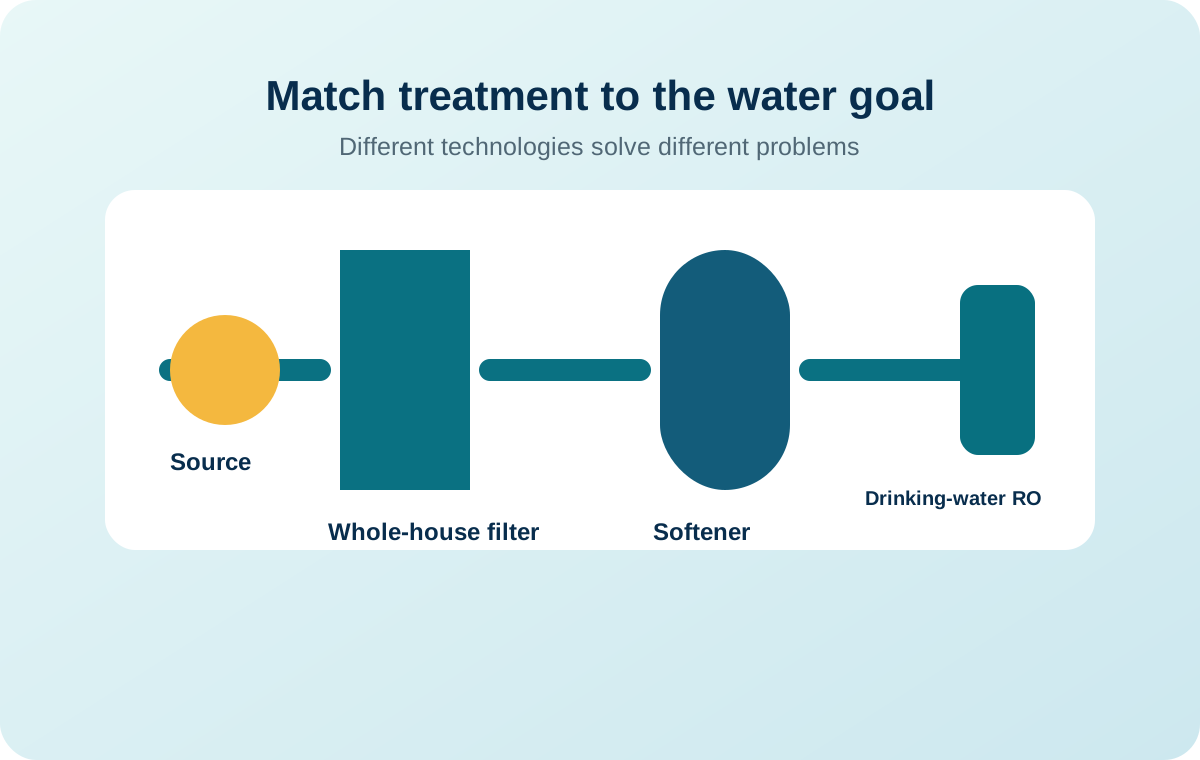
Three different treatment jobs
Treat incoming water for a documented concern that affects multiple fixtures, with media and flow sized for the exact property.
View system guideReduce measured calcium and magnesium hardness with an ion-exchange system sized for household demand, flow, and efficient regeneration.
View system guideTreat drinking and cooking water at a dedicated outlet with an exact system matched to the named reduction goal and operating conditions.
View system guide| Comparison point | Whole-house filtration | Water softeners | Reverse osmosis |
|---|---|---|---|
| Primary job | Model-specific treatment across the home | Reduce calcium and magnesium hardness | Model-specific drinking-water treatment |
| Typical location | Main water line / point of entry | Main water line / point of entry | Dedicated faucet / point of use |
| Best starting evidence | Water report or test tied to the named concern | Untreated hardness result with units | Named drinking-water goal and exact model claim |
| Whole-home treatment | Yes, when correctly sized | Yes, for hardness treatment | No, for the under-sink systems compared here |
| Hardness removal | Not unless a softening stage is included | Yes, with ion exchange | Not a whole-home hardness solution |
| Flow or production basis | Peak household service flow and pressure drop | Peak flow plus usable capacity between regenerations | Daily production, storage, pressure, and temperature |
| Typical plumbing needs | Main-line access, bypass, service space; sometimes drain or power | Main-line access, bypass, drain, brine access; often power | Feed, faucet, drain, cabinet space; sometimes power |
| Recurring upkeep | Cartridges or media, sanitation, performance checks | Salt or regenerant, brine care, settings, periodic service | Filters, membrane, sanitation, and performance checks |
| Key claim boundary | Placement alone does not prove what is reduced | Softening is not universal contaminant filtration | RO does not mean every substance is reduced |
Comparison boundary: These are category-level distinctions, not performance promises for an unnamed product. Verify the exact model, water conditions, rated operating limits, installation scope, and maintenance plan.
Need help deciding?
Begin with the source and concern. Add treatment only when the evidence and exact model support the job.
Compact research matrix
Filter nine common concerns by water source and decision type. Every row begins with evidence and ends with a limitation—the treatment category is only something to investigate.
| Concern | Evidence first | Treatment categories to investigate | Critical limitation |
|---|---|---|---|
| Calcium and magnesium hardnessPublic system + Private well | Measured hardness with units, sample location, date, household demand and peak flow. | Residential cation-exchange softening; compare capacity, efficiency, service flow and regeneration assumptions. Open related guide → | A softener is not a universal chemical filter or microbiological treatment. |
| Chlorine, chloramine, taste or odorPublic system | Confirmed public system, current report, exact disinfectant, affected fixtures and timing. | Activated-carbon or other media with the exact named claim, complete-train flow and rated capacity. Open related guide → | Taste and odor do not establish safety; chlorine and chloramine claims are not interchangeable. |
| Sediment, particles or turbidityPublic system + Private well | Particle or turbidity evidence, source pattern, hot-versus-cold behavior and whole-house flow. | Particle filtration or pretreatment sized to loading, micron claim, pressure loss and service interval. Open related guide → | A sediment filter does not establish reduction of dissolved chemicals or microorganisms. |
| Lead at a drinking-water tapPublic system + Private well | Appropriate tap sampling plus service-line, solder, fixture and premise-plumbing context. | Source correction plus point-of-use filtration or RO with an exact lead-reduction listing. Open related guide → | Boiling does not remove lead; a standard number without the named lead claim is incomplete. |
| PFAS such as PFOA or PFOSPublic system + Private well | Named analytes, current report or accredited-lab result, units and decision threshold. | Point-of-use granular activated carbon, ion exchange or RO with the exact PFAS claim and replacement plan. Open related guide → | EPA cautions that current certifications may not demonstrate reduction to its newer drinking-water limits. |
| Nitrate or nitritePublic system + Private well | Accredited-lab result, concentration, units, sample point and current source conditions. | Point-of-use RO or distillation with an exact nitrate claim, operating limits and post-treatment verification. Open related guide → | Do not infer nitrate performance from hardness removal, carbon media or a generic RO label. |
| ArsenicPublic system + Private well | Accredited-lab result, concentration, units, speciation when needed, pH and competing-water chemistry. | RO, distillation or chemistry-specific adsorptive treatment with an exact claim and verification plan. Open related guide → | Performance can depend on arsenic form and water chemistry; a generic media name is not enough. |
| Bacteria, viruses or parasitesPublic system + Private well | Official notice or appropriate microbial sampling, source integrity and sanitary conditions. | Official notice response, source correction and a validated disinfection or microbial-treatment train; UV may require pretreatment. Open related guide → | Ordinary sediment, carbon or softening equipment should not be assumed to make unsafe water safe. |
| Iron, manganese or stainingPublic system + Private well | Laboratory concentration and units, pH, dissolved-versus-oxidized form, odor and microbial context. | Chemistry-specific oxidation, filtration or other media; softening only within verified design limits. Open related guide → | Stain color alone does not identify the chemistry or prove which treatment will work. |
Clear the search or broaden the source and decision type. A missing row does not mean treatment is unavailable.
Direct answer: The best system is the least-complex option that addresses a documented concern at the right treatment location. Identify the exact utility or well, review current evidence, decide whether one tap or the whole home needs treatment, and compare exact model claims, flow, pressure, maintenance, consumables, and installation scope. No single filter is best for every Houston-area home.
If the first question is whether public-system or private-well guidance applies, use the city water vs well water treatment decision tree before comparing equipment.
Use the small contaminant and treatment-category matrix to compare evidence requirements, treatment categories worth investigating, and the most important limitation for nine common concerns.
“Best” is not a brand ranking. It is a match between the water source, household goal, plumbing conditions, and verified equipment capability. A scale-control system may be irrelevant to a lead concern, while point-of-use treatment may fit a kitchen-only goal.
Identify the public water system or private well serving the property. Houston Public Works reports on its system, while Greater Houston includes other municipalities and utility districts. Do not apply one system’s results or a neighbor’s equipment choice to every address.
For public water, review the current Consumer Confidence Report and any active utility notices. For a private well, use a source-specific testing plan and address well integrity or microbial concerns directly. CDC advises choosing treatment for substances of concern and notes that taste, odor, and appearance are not reliable indicators of safety.
Before ordering tests or equipment, narrow the pattern:
Use water testing when a property-specific concern cannot be resolved from the report, current notices, or plumbing diagnosis. Field screening for hardness or disinfectant is different from certified laboratory analysis for a health-related substance.
| Documented goal | Likely treatment category | Key limitation |
|---|---|---|
| Reduce sediment at many fixtures | Point-of-entry sediment filtration sized for particle load and flow | Does not establish reduction of dissolved substances |
| Address a specified whole-home taste, odor, or disinfectant concern | Point-of-entry media with the relevant claim and adequate contact/flow | Removing disinfectant increases the importance of plumbing hygiene and maintenance |
| Reduce calcium and magnesium hardness | Ion-exchange softener | A softener is not a universal contaminant filter |
| Change scale behavior without removing hardness | A clearly documented salt-free conditioner | Do not call it softening unless measured hardness is actually reduced under a substantiated claim |
| Reduce a named substance in drinking/cooking water | Certified point-of-use filter matched to that substance | Treats only the connected outlet |
| Reduce specified dissolved substances at a dedicated faucet | Point-of-use reverse osmosis with exact model claims | Produces a concentrate stream and needs pressure, drain access, and maintenance |
| Address microbial or complex private-well findings | Source correction plus a complete treatment and monitoring plan | Do not assume a general filter or RO membrane alone makes unsafe water safe |
The table routes the decision; it does not replace model verification. Every stage in a combined system should have a documented purpose.
Point-of-use equipment treats one defined outlet. It often fits drinking and cooking goals without treating showers, toilets, laundry, or irrigation. Cartridge filters and reverse osmosis systems can both serve this location, depending on the named reduction goal.
Point-of-entry equipment treats incoming water before distribution through the home. Whole-house water filtration may fit verified sediment or aesthetic concerns that occur broadly, or a named substance when the exact model has the required claim at household flow. It requires more space, plumbing access, and attention to pressure and maintenance.
Water softener systems are also usually point-of-entry, but their principal job is hardness removal by ion exchange. They should not be presented as interchangeable with carbon filtration or RO. No stage is justified unless evidence supports its purpose.
A correct technology can still disappoint when poorly sized. For point-of-entry systems, document pipe size, dynamic pressure, simultaneous fixture demand, required contact, rated flow, and pressure drop. Bedroom count is not a design calculation.
For under-sink systems, review cabinet space, feed, faucet, drain, power, refrigerator routing, production, and storage. RO output varies with pressure, temperature, dissolved solids, membrane condition, and tank backpressure.
Require the sizing inputs and model data. Oversizing can waste capacity; undersizing can reduce flow or cause early breakthrough. Read “up to” ratings with their test conditions.
Independent certification is valuable because it connects an exact model to defined tests. It is not a universal endorsement. CDC identifies standards including NSF/ANSI 42 for specified aesthetic effects, 53 for specified health-effect reductions, and 58 for reverse-osmosis systems. The model’s public listing must still name the actual claim that matters.
Use this verification sequence:
EPA adds a special caution for PFAS: current PFAS certifications may not necessarily demonstrate reduction to the agency’s newer drinking-water limits. For a health-critical target, define an appropriate post-treatment verification plan rather than assuming a badge guarantees every finished-water result.
Every treatment method creates upkeep. Cartridges need replacement; media tanks may require backwashing or media service; softeners need brine-system care; and RO units need filters, membranes, sanitation, and a working drain.
Before purchase, compare:
A low purchase price can become expensive with proprietary consumables or incomplete installation. Elaborate equipment is poor value when a narrower certified filter solves the problem.
Require proposals to state the evidence, goal, models, certified claims, design flow, pressure, included plumbing and electrical work, consumables, maintenance, exclusions, and total price. Confirm permit or inspection responsibility for the address and scope.
Reject fear-based or universal claims. “Purifies everything,” “maintenance-free,” “chemical-free,” and “medical-grade” have no decision value without definitions and evidence. Do not use a filter to bypass a utility advisory, damaged plumbing, or an unsafe well source.
A broad brand catalog may contain ion-exchange softeners, whole-home filters, scale conditioners, and point-of-use reverse osmosis. A good reputation in one category does not transfer every claim to every product carrying the same name. First choose the treatment location and mechanism; then compare exact models on the same water inputs, flow, certification claim, maintenance, installation scope, parts path, and warranty terms.
The directory includes research guides for Watts, North Star, HALO, and Gemline/Nugen systems. Exact local model availability and any dealer relationship still require written confirmation, so the water treatment system brands guide treats manufacturer documentation and local availability as separate questions.
Gather the property address, utility or well name, current report, relevant test results, photos of the main line or under-sink area, pressure information if available, household flow needs, and the exact outcome sought. This lets proposals address the same problem instead of selling different equipment under the same category label.
Publisher disclosure: Water Filtration Houston is an independent publisher and provider directory, not the installer. This guide does not replace a property review, fit-for-purpose testing when needed, exact manufacturer documentation, or a written provider proposal.
Review the current public-system report and notices first. Test when an address-specific concern, private well, plumbing issue, or treatment target is not resolved by those sources. Use a fit-for-purpose method; a hardness strip and an accredited laboratory analysis answer different questions.
Neither is universally better. Whole-house equipment treats incoming water for many fixtures; an under-sink unit concentrates treatment at one outlet. Choose the location that fits the documented goal without treating unnecessary water.
A standard ion-exchange softener primarily addresses calcium and magnesium hardness. Do not assume it reduces chlorine, PFAS, lead, microorganisms, or other substances unless the exact model has a specific substantiated claim.
Look for the exact model’s certification for the named reduction you need. A standard number or logo alone is not enough. Confirm the claim, capacity, flow, pressure, and replacement conditions in the current listing.
There is no ideal stage count. Each stage should address a documented condition or protect another component. Extra cartridges can add pressure loss, maintenance, and cost without improving the result that matters.
Provider directory
Explore each category
Treat incoming water for a documented concern that affects multiple fixtures, with media and flow sized for the exact property.
View system guide →Reduce measured calcium and magnesium hardness with an ion-exchange system sized for household demand, flow, and efficient regeneration.
View system guide →Treat drinking and cooking water at a dedicated outlet with an exact system matched to the named reduction goal and operating conditions.
View system guide →