What it can address
Specified drinking-water substances when the exact system has the relevant verified claim.
Houston homeowner guide · Point-of-use drinking-water guide
Treat drinking and cooking water at a dedicated outlet with an exact system matched to the named reduction goal and operating conditions.
Decision snapshot
Use the category to narrow the decision, then verify the exact water evidence, model, flow, installation, and upkeep.
Specified drinking-water substances when the exact system has the relevant verified claim.
RO does not mean “removes everything,” and an under-sink unit does not treat showers or appliances.
Utility or well evidence, named goal, pressure, pretreatment, cabinet space, faucet, drain, and production.
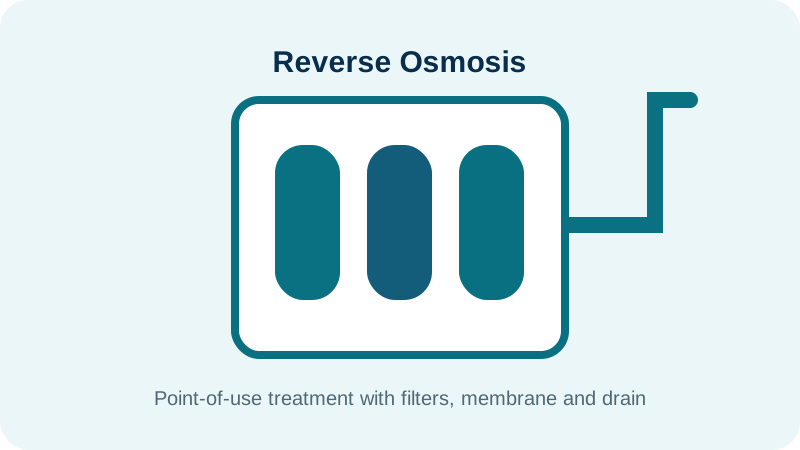
Prefilters, membrane, postfilter, sanitation, replacement parts, and concentrate flow.
Important boundaryThe membrane is only one part of the system; certification, performance, and maintenance apply to the exact complete model.
Direct answer: An under-sink reverse osmosis system treats drinking and cooking water at a point of use, but no generic RO claim fits every model. Houston homeowners should identify the exact utility, review its current water report, define the substance or aesthetic concern, and choose a system whose certified listing names that reduction claim. Pressure, pretreatment, drain connection, faucet capacity, and maintenance also affect performance.
Residential reverse osmosis commonly serves a dedicated faucet at the kitchen sink and, when the design allows, a refrigerator or ice maker. Water passes through prefilters and a semipermeable membrane; a storage tank or tankless pump arrangement then supplies treated water. Because this configuration concentrates treatment at drinking and cooking outlets, it can be more appropriate than treating shower, toilet, laundry, and irrigation water for a concern limited to ingestion.
That distinction matters in Houston. Houston Public Works describes its municipal system as regulated under federal and state law and says the system has TCEQ’s “Superior” rating. The right question is not whether every home needs RO. It is whether a specific household goal—such as reducing a named dissolved substance or changing drinking-water taste—matches the exact proposed model’s evidence.
Identify the address’s public water system before shopping. Greater Houston includes multiple utilities and municipal utility districts as well as private wells. Read the current Consumer Confidence Report for that system and use appropriate household testing when the report does not resolve a premise-plumbing, private-well, or address-specific concern. Taste, odor, and appearance can guide investigation, but CDC says they are not reliable indicators of safety.
RO can reduce specified dissolved substances when the exact system is certified or otherwise supported for those claims under defined conditions. The membrane is only one part of the unit. Prefilters protect it, carbon stages may address specified aesthetic or disinfectant-related concerns, and postfilters may affect finished-water taste. A proposal should identify the purpose of every stage rather than using stage count as a quality score.
Never convert “uses reverse osmosis” into “removes everything.” Do not promise 100% removal of PFAS, lead, arsenic, fluoride, bacteria, viruses, or any other substance. Claims must be tied to the exact model, named reduction, test standard, rated capacity, replacement schedule, pressure range, and other listing conditions. Our guide to what reverse osmosis removes shows how to check a claim without treating all RO systems as interchangeable.
| Buying question | Evidence to review | Why it matters |
|---|---|---|
| What do you want to reduce? | Utility report or appropriate laboratory result | Selection should begin with a named concern, not a general fear claim |
| Does the exact model support that claim? | Certifier’s current listing and manufacturer documentation | NSF/ANSI 58 identifies an RO system category, but each listed reduction claim is model-specific |
| Is incoming pressure adequate? | Measured dynamic pressure and model operating range | Low pressure can reduce production and efficiency; some units use a pump |
| Is pretreatment needed? | Hardness, sediment, disinfectant, iron/manganese where relevant, and model limits | Water chemistry and fouling can affect membrane life and performance |
| How much treated water is available? | Tank usable volume or tankless production rating under stated conditions | Label capacity may differ from real delivery at the home’s pressure and temperature |
| What goes to the drain? | Manufacturer recovery or efficiency data under stated conditions | RO produces a treated stream and a concentrate stream; ratios vary by system and conditions |
| How is performance maintained? | Filter and membrane schedule, indicator logic, and replacement availability | Deferred maintenance can reduce quality and invalidate performance assumptions |
CDC identifies NSF/ANSI 58 as a standard for reverse osmosis systems. That does not mean every system associated with Standard 58 reduces every substance covered by any listing. Check the current certifier database for the exact model number and read the named reduction claims. Match those claims to the household’s evidence.
EPA’s PFAS guidance is especially important. EPA recommends looking for a filter certified to reduce PFAS, but notes that current PFAS certifications may not necessarily demonstrate reduction to the agency’s newer drinking-water limits. A PFAS badge should not be turned into a guarantee that finished water will meet a regulatory value at every incoming concentration. Verify the model, maintain it as directed, and use appropriate post-treatment testing when the outcome is health-critical.
Manufacturer materials show residential reverse-osmosis equipment within the Watts and North Star product families. HALO publishes the Ultra Plus H-RO-PLUS system; its nominal membrane description and certified daily production figure are different measurements and should not be substituted for one another. Current first-party evidence reviewed for this project did not establish a Gemline-branded reverse-osmosis line.
Manufacturer coverage does not establish that a particular Houston provider currently supplies or services a model. Before treating a brand as an option, ask the provider for the exact system designation, current certifier listing, replacement-element numbers, production conditions, parts availability, and written warranty process. The water treatment system brands guide separates manufacturer scope from current local availability.
RO production ratings are established under specified test conditions. Actual output can vary with incoming pressure, temperature, total dissolved solids, membrane condition, and tank backpressure. A qualified assessment should measure pressure while water is flowing, check the proposed unit’s operating range, and determine whether a booster pump or pressure correction is appropriate.
Hardness does not mean RO is impossible, but scale can affect membrane performance. The system manufacturer’s limits and the home’s measured water chemistry should guide pretreatment. In a home with substantial hardness, a softener may protect an RO membrane, while the RO unit remains the point-of-use drinking-water stage. It does not soften the whole home.
Municipal disinfectant type also matters for prefilter selection and membrane protection. Use the exact utility’s current report and the manufacturer’s documentation; do not infer the disinfectant for every Houston-area address from a city name. Private-well systems require a different diagnostic path, including appropriate microbial and chemistry testing. RO should not be presumed to disinfect microbiologically unsafe water unless the complete system has specific evidence and the source problem is professionally addressed.
A typical under-sink installation may include a feed-water connection, sediment and carbon prefilters, membrane housing, storage tank or pump, dedicated faucet, drain connection, shutoffs, and tubing. Refrigerator or ice-maker service changes the pressure, distance, and capacity calculation. Limited cabinet space, stone countertops, existing dispensers, drain configuration, and electrical access can affect scope.
Use this pre-installation checklist:
Houston-area plumbing jurisdiction varies by exact location. A broad claim that an RO installation never needs a permit or always needs one is not reliable. Resolve the authority having jurisdiction from the property address, final connection method, and work scope.
Prefilters protect the membrane and may perform separate treatment functions. Postfilters affect finished-water taste. The membrane itself has a service life, but no universal replacement interval applies. Incoming water, use, pressure, pretreatment, and the manufacturer’s schedule all matter.
Ask whether replacement elements are proprietary, locally available, and included in any service plan. Confirm what the indicator actually measures; a timer is not the same as direct contaminant monitoring. Our reverse osmosis maintenance guide covers a practical recordkeeping schedule, and the reverse osmosis system cost guide helps compare consumables, wastewater, parts, and service over time.
Choose by treatment location and goal. RO is commonly used for drinking and cooking water at one point of use. A whole-house filter treats incoming water before distribution to many fixtures. A softener addresses hardness. Some homes use more than one technology, but each stage should have a documented purpose.
Do not buy a whole-house system merely because more treatment sounds better, and do not expect an under-sink RO unit to change scale or water feel at showers. The whole-house filter vs reverse osmosis comparison maps concerns to the least-complex suitable treatment location.
Gather the service address, utility or well name, current water report, any laboratory results, the named treatment goal, under-sink and countertop photos, available cabinet dimensions, refrigerator connection needs, pressure information if known, and preferred faucet location. Give each listed provider the same information and ask for an itemized proposal naming the exact model, certified claims, operating conditions, replacement schedule, and verification plan.
Publisher disclosure: Water Filtration Houston is an independent publisher and provider-matching service, not the company that performs installation. Provider availability, equipment, installation requirements, credentials, warranty terms, and price must be confirmed directly with the selected provider.
An under-sink RO decision should use the current report for the system serving the property, plus targeted testing when the concern is household-specific. The Greater Houston city guides help separate city names from utility identity before an exact RO model and certified claim are compared.
No. CDC advises reviewing the public water report or testing first and selecting treatment for substances of concern. RO may suit a defined drinking-water goal, but some households may need no filter, a simpler point-of-use filter, or a different technology.
No. Performance varies by model, substance, incoming concentration, pressure, temperature, condition, and maintenance. Use the exact certifier listing and manufacturer documentation for each proposed reduction claim; avoid universal percentages.
Most residential RO systems discussed here are point-of-use units for a dedicated drinking-water faucet. Whole-house RO is a different, more complex scope involving storage, repressurization, pretreatment, concentrate management, and plumbing design.
No. An under-sink RO system treats water delivered through its dedicated line. It does not address hardness at showers, water heaters, or other fixtures. Whole-home hardness treatment is a separate softener decision.
Follow the exact model’s manual and certified-claim conditions. Water use, incoming sediment, disinfectant, hardness, pressure, and pretreatment can change service life. A calendar estimate is not a substitute for the manufacturer’s limits and performance checks.
RO separates feed water into treated water and a concentrate stream that goes to drain. The ratio varies by design and operating conditions. Compare manufacturer recovery or efficiency data under stated conditions rather than relying on one universal ratio.
Compare treatment jobs
Treat incoming water for a documented concern that affects multiple fixtures, with media and flow sized for the exact property.
View system guide →Reduce measured calcium and magnesium hardness with an ion-exchange system sized for household demand, flow, and efficient regeneration.
View system guide →