Direct answer: Reverse osmosis can reduce many dissolved substances, but only the exact system’s tested claims are defensible. Depending on the model, those claims may include total dissolved solids and named substances such as lead, fluoride, arsenic, nitrate, or certain PFAS. RO does not literally remove everything, and performance depends on incoming water, pressure, pretreatment, membrane condition, capacity, and timely maintenance.
How reverse osmosis separates water
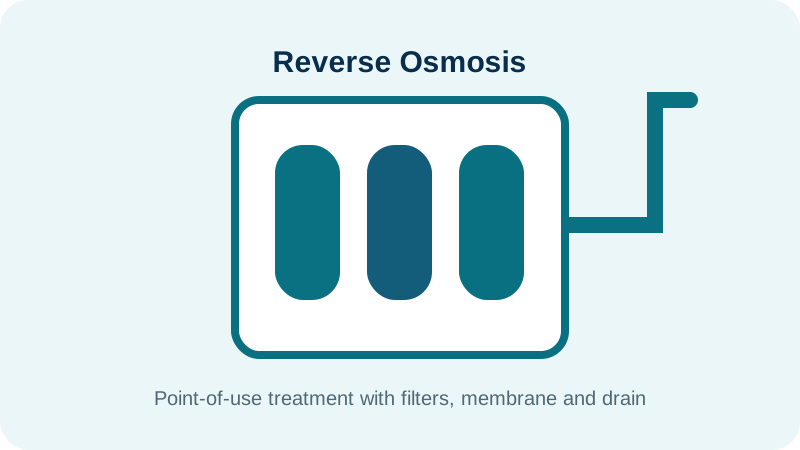
An RO unit pushes feed water across a semipermeable membrane. Some water passes through as treated permeate; a second stream carries concentrated dissolved material to the drain. Most residential units add sediment and carbon prefilters to protect the membrane and may include a postfilter for finished-water taste. Each stage has a different job.
That distinction prevents a common buying mistake: treating the word “RO” or a high stage count as proof of every possible reduction. The complete model must be evaluated as listed and operated.
Residential reverse osmosis systems are usually point-of-use equipment for drinking and cooking water. An under-sink unit does not treat showers, laundry, water heaters, or every cold-water tap unless those outlets are separately connected.
What an RO system may reduce
The useful answer begins with a named concern and ends with the exact model’s certification record. These categories are a screening guide, not a promise that every unit carries every claim.
| Substance or concern | What RO may do | What must be verified |
|---|---|---|
| Total dissolved solids (TDS) | Reduce the combined dissolved-ion reading | Exact model claim, test conditions, membrane condition, and how the reading will be interpreted |
| Lead and other named metals | Reduce a listed metal when certified for that claim | Model number, specific metal, rated capacity, replacement schedule, and premise-plumbing context |
| Fluoride, arsenic, nitrate or similar dissolved constituents | Reduce only those constituents named in the listing | The substance, incoming limits, operating pressure, and any pretreatment requirements |
| Certain PFAS | Some RO models have PFAS-reduction claims | Exact certified claim plus EPA’s caveat about current certification protocols and newer federal limits |
| Taste or odor | Carbon stages may improve specified aesthetic conditions | Whether the claim belongs to the carbon stage, the RO system, or neither |
| Hardness minerals | Lower calcium- and magnesium-related dissolved content at the RO faucet | This does not soften the rest of the home; scaling potential and pretreatment still matter |
| Microorganisms | No universal RO disinfection claim applies | Source safety, complete-system listing, integrity, sanitation, and any separate disinfection barrier |
A utility report describes regulated monitoring for a public water system during a reporting period. It does not diagnose a private well or every possible contribution from a home’s service line, water heater, fixtures, or premise plumbing. Use appropriate water testing when an address-specific result is needed.
PFAS claims need an extra check
EPA advises consumers to look for filters certified to reduce PFAS, including certain systems using reverse osmosis or activated carbon. EPA also warns that current certification standards for PFAS filters may not necessarily show reduction to the agency’s newer drinking-water limits. A PFAS badge is therefore useful evidence, not an unconditional guarantee.
For a PFAS concern, identify the exact compound or claim in the certifier’s record, read the manufacturer’s use conditions, and follow replacement limits. If the outcome is health-critical, discuss sampling design and post-treatment confirmation with an appropriately accredited laboratory. Do not infer a result from a generic TDS meter; TDS does not identify individual PFAS.
Lead depends on both water and plumbing
Lead can enter drinking water through service lines and premise-plumbing materials. A system report cannot answer every household lead question, and boiling does not remove lead. EPA recommends using a filter certified for lead reduction when filtration is selected and replacing cartridges as directed.
For an RO proposal, verify that the exact model—not merely the brand or membrane type—has the relevant lead claim. Sampling may be appropriate when the home’s plumbing history, service-line material, or a prior result creates a specific concern. The treatment plan should also address the source rather than presenting a filter as permission to ignore damaged or suspect plumbing.
Minerals, TDS, and “purity” claims
RO commonly lowers dissolved mineral content at its dedicated faucet. That can change taste and reduce the TDS reading, but TDS is a combined measurement rather than a list of substances. A low number does not prove microbiological safety, and a high number does not identify which ions are present or whether they exceed a health standard.
Remineralization is a taste or product-design choice, not a universal health requirement. Compare its documented function and effect on finished-water chemistry rather than relying on “alkaline” wording.
What RO may not solve
RO is a poor substitute for diagnosis. It may not be the right response to:
- a temporary utility advisory, main break, or flushing event;
- hot-water-only odor or discoloration originating at the water heater;
- one-fixture symptoms caused by an aerator, faucet, or local supply line;
- whole-home hardness, scale, or pressure concerns outside the RO faucet;
- microbiologically unsafe well water without a complete source-control and disinfection plan;
- contaminants absent from the exact model’s certified claims;
- inadequate pressure, excessive fouling, or installation conditions outside the manufacturer’s limits.
CDC notes that taste, odor, and appearance are not reliable safety indicators. Symptoms can guide investigation, but they cannot select a treatment system by themselves.
How to verify the exact model
Use the water filter certifications guide as a companion, then apply this five-step check:
- Record the complete model number, including suffixes that distinguish variants.
- Find the model in the certifier’s current public database rather than relying only on packaging.
- Confirm the applicable standard and each named reduction claim relevant to the household goal.
- Read capacity, pressure, temperature, replacement, flushing, and source-water conditions.
- Compare the listing with the manufacturer’s current manual and proposed installation scope.
NSF/ANSI 58 is the principal standard CDC identifies for reverse-osmosis systems, but seeing “58” does not mean every model reduces every substance associated with RO. Certification is model- and claim-specific.
Maintenance protects the claim
Prefilters, the membrane, postfilters, tank or pump, faucet, tubing, and drain connection all require attention. Follow the exact manual rather than a generic replacement calendar. Incoming sediment, hardness, disinfectant, water use, pressure, temperature, and storage conditions can change service needs.
Keep model numbers, installation date, replacement parts, service dates, and baseline readings together. A timer light usually tracks time or volume; it is not direct proof that every target substance remains below a chosen level. Leaks, unusual drain flow, a sudden production change, or sanitation concerns warrant prompt troubleshooting under the manufacturer’s procedure.
Prepare a claim-specific comparison packet
Bring the utility or well name, current water report, any relevant laboratory result, the exact concern, available pressure information, under-sink dimensions, and refrigerator-line needs. Give each listed provider the same information and ask for a written proposal naming the model, certified reductions, operating limits, pretreatment, replacement parts, and verification method.
Publisher disclosure: Water Filtration Houston is an independent publisher and provider-matching service, not the company that performs installation. Provider availability, equipment, installation requirements, credentials, warranty terms, and price must be confirmed directly with the selected provider.
Frequently asked questions
Does reverse osmosis remove PFAS?
Some RO systems are certified for specified PFAS-reduction claims. Verify the exact model in a current certifier database and read EPA’s warning that existing certification protocols may not necessarily demonstrate reduction to newer federal limits.
Does reverse osmosis remove lead?
An RO system may reduce lead when the exact model is certified for that claim and maintained under its listing conditions. Because lead can come from service lines or household plumbing, source investigation and properly designed testing may still be needed.
Does RO remove healthy minerals?
RO generally lowers dissolved ions, including minerals, at the treated faucet. Whether that matters for taste or a household preference is separate from the system’s safety claims. Do not treat remineralization as a universal health requirement.
Can a TDS meter prove that RO water is safe?
No. A TDS meter estimates combined dissolved-ion content; it does not identify individual chemicals, PFAS, lead, bacteria, or viruses. Use it only for the limited purpose supported by the system manual and use appropriate analysis for specific concerns.
Does RO make well water safe to drink?
Not by default. Private wells require source-specific testing and a treatment plan matched to the findings. RO should not be assumed to disinfect unsafe water unless the complete system has the required evidence and all source, pretreatment, sanitation, and maintenance needs are addressed.