Direct answer: Start a Houston home water assessment by identifying the exact utility and reading its current Consumer Confidence Report. Use household testing when the report cannot answer an address-, plumbing-, well-, or treatment-specific question. Field strips and meters can screen for selected properties such as hardness, but health-contaminant decisions generally require appropriate sampling and a qualified laboratory—not a sales demonstration or taste test.
Begin with the exact water system
“Houston water” is not one sample. The City of Houston operates a large system, but the metro also includes other municipalities, municipal utility districts, purchased-water systems, and private wells. The report that matters is the current report for the system serving the property.
Houston Public Works describes its drinking-water operation as a regulated public-health agency and says its system maintains TCEQ’s “Superior” rating. The City reports serving approximately 2.2 million customers across more than 600 square miles in four counties. That scale is one reason not to infer a fixture-level result from a city name alone.
Texas public water systems regularly test for regulated contaminants, according to TCEQ, and community systems issue annual Consumer Confidence Reports. Those reports summarize source information, regulated testing, detected levels, compliance context, and required health information for a reporting period. They are the right first stop for broad questions about public water. Use the Houston water quality guide to locate and read the relevant report.
What question are you trying to answer?
Do not begin with the largest available test panel. Begin with the decision the result must support. “Is my water good?” is too broad to define sampling, method, or treatment. A better question identifies the observed issue, location, timing, water source, and intended use of the result.
| Question or observation | First evidence to check | Possible next step | What not to conclude |
|---|---|---|---|
| Utility-wide regulated water quality | Current report for the exact public water system and current notices | Contact the utility for report questions | A system report is not a sample from one kitchen tap |
| Scale, spotting, or poor soap lather | Untreated cold-water hardness screening with units | Use the result for softener assessment | Hardness does not establish that water is unsafe |
| Taste, odor, or color change | Hot vs. cold, one fixture vs. all, current notices, source information | Utility contact, plumbing review, or targeted test | Sensory changes cannot prove safety or contamination |
| Lead concern at a household tap | Utility guidance, service-line and premise-plumbing context | Use a laboratory and sampling protocol appropriate for lead | A generic dip strip or boiling does not resolve a lead concern |
| PFAS or another named health contaminant | Current utility report and official guidance | Discuss appropriate accredited-lab analysis and detection limits | A broad “water quality” screen is not automatically suitable |
| Existing treatment performance | Exact model, certified claim, maintenance record, before/after sampling plan | Test with a method suitable for the named claim | TDS alone does not verify removal of every contaminant |
| Private-well safety or change | Well history, flooding/repair events, source construction, local guidance | Appropriate microbial and chemical laboratory testing | Municipal compliance results do not describe a private well |
Field screening versus laboratory analysis
Field tools are useful when their limits match the decision. A hardness kit can support water-softener sizing when it reports a usable value and units. A chlorine test may help with a narrow operational check when the disinfectant form, method, and timing are appropriate. A conductivity or total dissolved solids meter can track a broad water property or help monitor relative RO membrane behavior.
None of these readings is a universal safety test. TDS does not identify which dissolved substances are present. A hardness value does not measure lead, PFAS, microorganisms, or pesticides. A sales demonstration that changes color may show a reaction, but without a validated method, calibration, quality controls, and defined analyte, it should not be treated as certified laboratory evidence.
Laboratory testing is appropriate when the result will drive a health-contaminant decision, document a private-well condition, investigate premise-plumbing exposure, or verify a specific treatment claim. Method selection matters. So do the container, preservative, flush or first-draw protocol, sample location, holding time, shipping conditions, detection limit, and chain of custody. A laboratory report is only as relevant as the sampling plan behind it.
Municipal water and private wells require different plans
For public water, begin with the utility report and current notices. If the concern involves one fixture, hot water only, a recent plumbing change, an older service line, or an existing filter, design the sample around that hypothesis. Contact the utility when the issue may be distribution-related. Contact a qualified plumbing professional when the pattern points to premise plumbing.
Private-well owners are responsible for source-specific monitoring and should not use a municipal report as a substitute. Testing needs can change after flooding, well repair, loss of pressure, changes in taste or appearance, nearby land-use events, or illness concerns. Use official health or environmental guidance to define microbial, inorganic, and other testing relevant to the well and local conditions. A treatment seller’s standard panel may not cover the correct risks.
How results should guide equipment
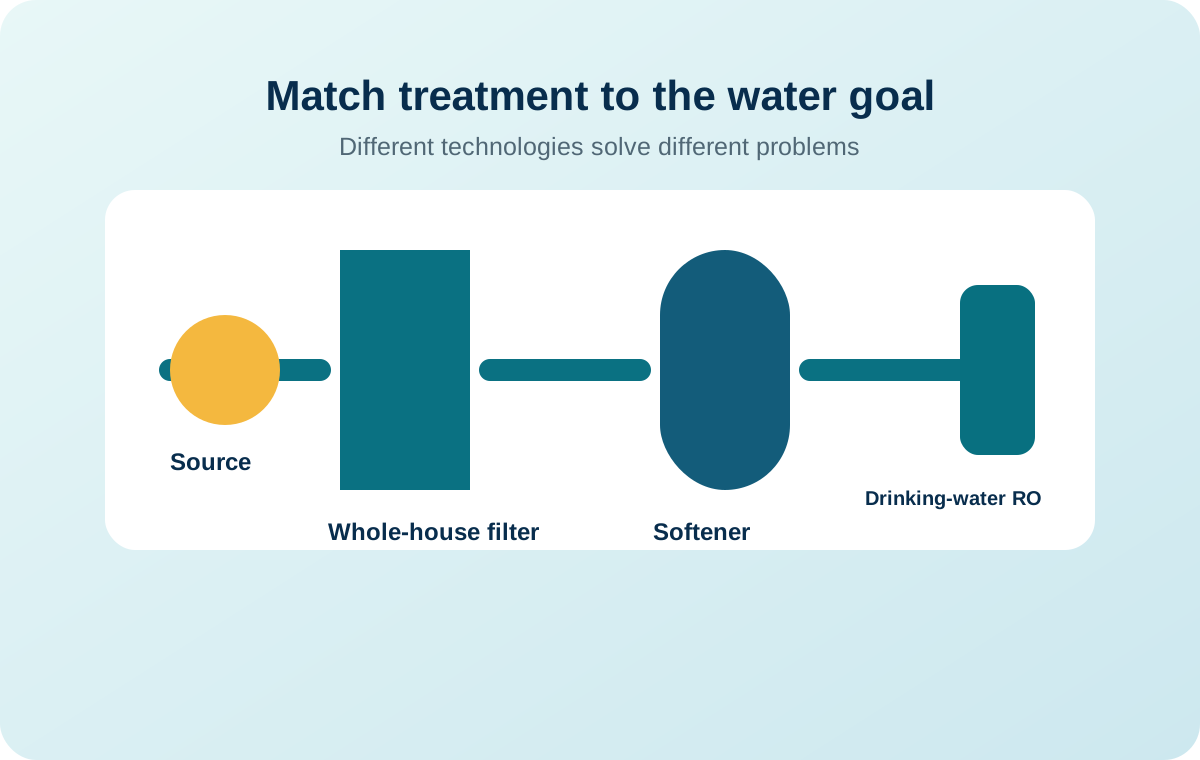
A report does not automatically prescribe a product. Compare the supported finding with model-specific evidence, whether the appropriate location is whole-house water filtration or a single tap. CDC recommends testing water or reviewing the public system’s annual report and choosing a filter for the substances of concern. It also notes that taste, odor, and appearance are not reliable indicators of safety. Check water filter certifications claim by claim rather than relying on a standard number alone.
Use this test-to-treatment checklist:
- Identify the exact water source and public system, if applicable.
- Read the current report and current utility notices.
- Define the concern as aesthetic, operational, or health-based.
- Determine whether the condition appears at one fixture, all fixtures, hot water, cold water, or both.
- Choose screening or laboratory analysis that fits the decision.
- Preserve sample date, location, protocol, units, method, and reporting limits.
- Match the supported finding to a treatment technology.
- Verify the exact model’s certified listing and named reduction claim.
- Compare rated flow, capacity, incoming-water limits, installation, and maintenance.
- Plan post-installation verification appropriate to the original concern.
What the directory can—and cannot—provide
Water Filtration Houston organizes water-source, utility-report, testing, treatment, and provider research. It does not perform testing, issue certified laboratory reports, diagnose a property, or select equipment for a consumer. Confirm any field-screening, sample-collection, laboratory-referral, and treatment scope directly with the responsible provider or laboratory.
Before accepting any “free water test,” ask exactly what is measured, who performs it, whether the output is screening or certified laboratory analysis, which methods are used, and whether equipment sales influence the recommendation. A field hardness or disinfectant screen can be useful when accurately labeled. It should not be presented as a comprehensive safety result.
A contractor who reviews a report should distinguish observed data from sales interpretation. The recommendation should state the target issue, exact proposed model, certified claim where relevant, operating assumptions, maintenance requirements, and what remains untested. If a health concern falls outside the contractor’s scope, the appropriate next step is a qualified laboratory or public-health source—not an equipment promise.
Prepare a water-assessment file
Collect the service address, water bill or utility name, current Consumer Confidence Report, recent utility notices, photos of affected fixtures, notes on when and where symptoms occur, plumbing or water-heater changes, existing treatment model and maintenance history, and all prior laboratory reports. Keep original PDFs with dates, methods, units, and reporting limits.
Use that file when comparing providers to define the question and the evidence needed before equipment is selected. Do not purchase treatment solely from an unlabelled demonstration.
Publisher and testing boundary: Water Filtration Houston is an independent publisher and provider directory, not a utility, installer, certified laboratory, or public-health agency. Laboratory work must come from an appropriately qualified laboratory, and field screening must be described accurately rather than presented as a comprehensive safety test.
Related water-evaluation guides
- Well water treatment
- Houston water quality
- Houston water hardness
- Is Houston tap water safe?
- Water filter certifications
Frequently asked questions
Is Houston tap water safe to drink?
The City describes its system as regulated and reports a TCEQ “Superior” rating. Review the current report and notices for the exact system serving the address. A household-specific concern involving plumbing, a private well, or a named contaminant may require additional investigation; taste alone cannot answer safety questions.
Can a home test kit detect every contaminant?
No. Kits and meters measure only the properties or analytes their methods support. A hardness strip, chlorine test, pH reading, or TDS meter is not a comprehensive safety test. Use an appropriate laboratory method for health-contaminant decisions.
Should I test before buying a water softener?
Yes. Obtain untreated hardness with a value and units. Depending on the water source and model, iron, manganese, flow, and other inputs may also matter. Do not size from a generic Houston hardness claim. See the Houston water hardness guide for the data to collect.
When should municipal-water users order laboratory testing?
Consider it when the utility report does not answer a property-specific question, the concern may come from service lines or premise plumbing, a named health contaminant requires tap-level evidence, or treatment performance must be verified. Define the analyte and sampling protocol first.
Is a free dealer water test a laboratory test?
Not necessarily. Ask which analytes are measured, the method, detection limits, quality controls, and who issues the result. Field screening can be useful when labeled accurately, but it must not be represented as certified laboratory analysis unless it actually meets that standard.
How do I test whether a filter is working?
Start with the exact model’s supported claim and maintenance conditions. Use before-and-after sampling or a baseline and post-treatment sample with a method appropriate to the named substance. TDS tracking alone cannot verify unrelated contaminant reductions.
Sources
- Houston Water — Houston Public Works
- Drinking Water Taste, Odor and Color — Houston Public Works
- Houston Drinking Water Quality Report — Houston Public Works
- How Is My Drinking Water Quality? — TCEQ
- Consumer Confidence Reports — TCEQ
- About Choosing Home Water Filters — CDC
- WaterSense Guide to Selecting Water Treatment Systems — EPA
- Identifying Drinking Water Filters Certified to Reduce PFAS — EPA