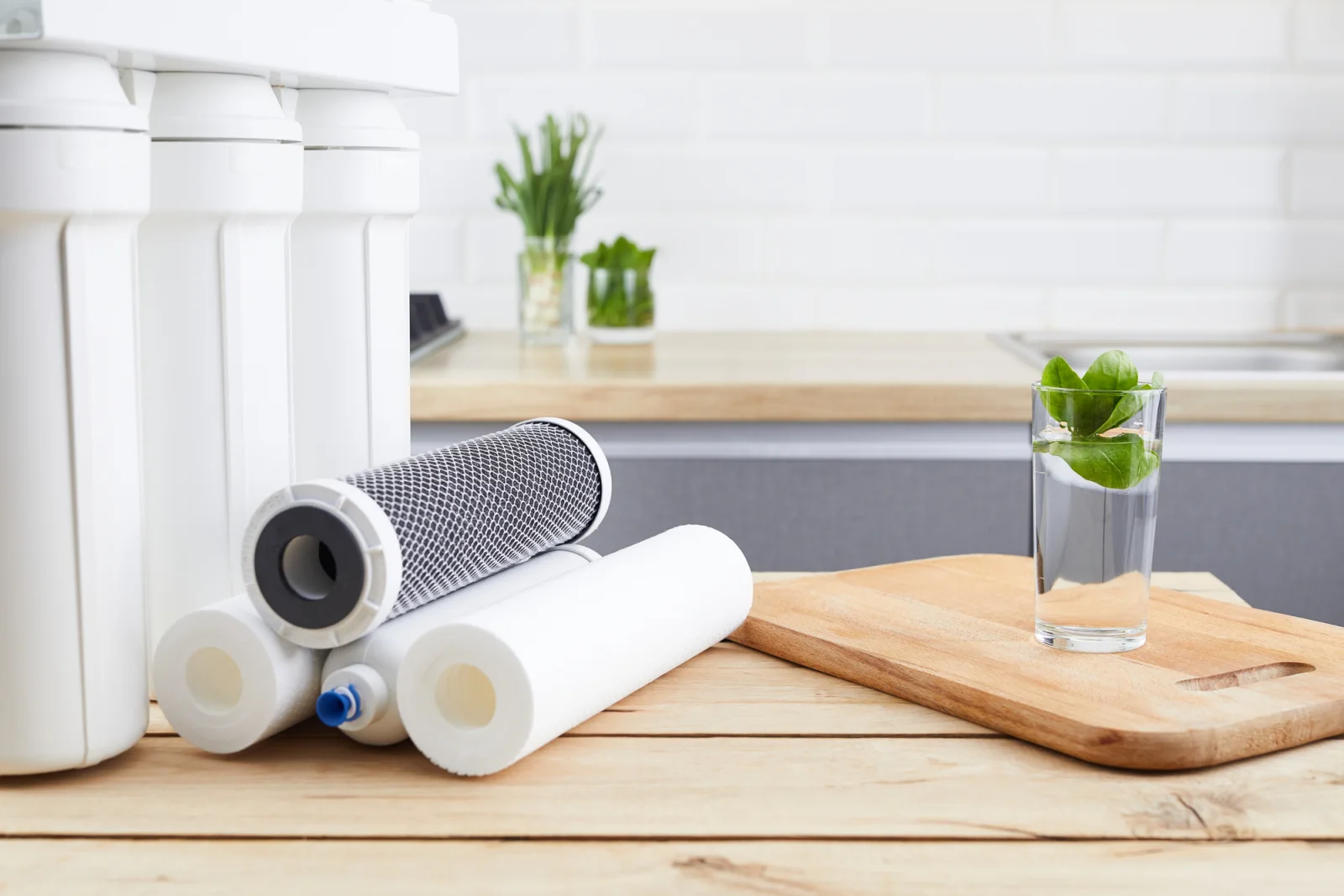
Water filter certification is meaningful when an accredited certifier lists the exact model for the exact standard and performance claim a buyer needs. “NSF certified” by itself is incomplete. Check who certified the product, the model designation, named reduction, rated capacity and flow, required replacement schedule, and operating conditions before treating a badge as evidence.
Use the certification category and claim checker to identify the likely standard category and expose missing model, listing, claim, or configuration evidence.
Certification, a laboratory test, and a product listing are different
These terms are often blended together in sales materials, but they answer different questions.
- A standard defines test methods and requirements for matters such as material safety, structural integrity, or a specified performance claim.
- Certification is an independent conformity-assessment process. It can include product testing, documentation review, manufacturing oversight, and continued compliance requirements.
- A test report describes what a submitted sample did under the test conditions. By itself, it may not establish ongoing certification of products sold under the same name.
- A public listing is the certifier’s searchable record of the covered manufacturer, exact model or model family, standard, and claims.
A product can be tested “to” a standard without being currently certified by an accredited body. It can also be certified for material or structural requirements without being certified for the contaminant reduction featured in an advertisement. Ask for the public listing rather than relying on a logo, screenshot, or undated PDF.
Read the claim, not just the standard number
Certification does not turn a treatment category into a universal purifier. A standard may contain many optional performance claims, and a model may be listed for only one or several of them. The listing should name the specific effect or substance.
Suppose two products both reference NSF/ANSI 53. One may be certified for cyst reduction and another for lead reduction. The shared standard number does not make their claims interchangeable. Likewise, a reduction percentage measured under laboratory conditions is not a promise of zero concentration at every home. Incoming level, water chemistry, pressure, flow, capacity, temperature, and replacement timing can all matter.
For a property-specific concern, review the correct utility report and use appropriate testing when that report cannot resolve a household-plumbing, private-well, or health-based question. Taste, odor, scale, and color cannot identify all substances or establish safety on their own.
Common NSF/ANSI standards buyers encounter
The following table is a navigation aid, not a substitute for the exact listing.
| Standard | Common scope | What it does not prove by itself |
|---|---|---|
| NSF/ANSI 42 | Drinking-water treatment units with specified aesthetic effects, such as particular taste, odor, chlorine, or particulate claims | That the model reduces lead, PFAS, microorganisms, hardness, or every chemical |
| NSF/ANSI 53 | Drinking-water treatment units with specified health-effect reduction claims | That every model listed under 53 has every available 53 claim |
| NSF/ANSI 58 | Reverse osmosis systems, including requirements and model-specific reduction claims | That every RO unit removes every dissolved substance or treats the whole house |
| NSF/ANSI 44 | Residential cation-exchange water softeners | That a softener is a general contaminant filter or disinfection system |
| NSF/ANSI 55 | Ultraviolet microbiological water-treatment systems with defined classifications and operating requirements | That UV removes dissolved chemicals, sediment, or hardness |
| NSF/ANSI 401 | Treatment-unit claims for certain emerging compounds or incidental contaminants | That all unregulated compounds or PFAS are covered |
| NSF/ANSI/CAN 61 | Health-effects requirements for materials and components that contact drinking water | A contaminant-reduction claim for the complete treatment unit |
Whole-home and point-of-use products can fall under different standards and configurations. A buyer considering whole-house water filtration should pay particular attention to service flow and capacity at the claimed performance. Someone comparing reverse osmosis systems should verify the complete system configuration, not assume that a membrane component’s documentation covers the assembled unit. Use appropriate water testing to define a property-specific concern before trying to match that concern to a certified claim.
How to verify an exact model and claim
Use this sequence for every proposal:
- Define the target. Name the aesthetic effect, hardness issue, microorganism, or measured substance. Avoid goals such as “remove everything.”
- Record the full model number. Include suffixes, flow ratings, tank sizes, faucets, cartridges, and replacement-element numbers. Similar names can cover different configurations.
- Identify the certifier. NSF is both a standards-development organization and a certifier, but other accredited organizations also certify products to NSF/ANSI standards. The certifier’s name should be clear.
- Open the certifier’s current public listing. Search by manufacturer and model; do not rely only on the manufacturer’s product page.
- Match the named claim. Confirm the standard and exact reduction or performance language.
- Read the conditions. Note rated capacity, flow, pressure, temperature, influent conditions, required pretreatment, and replacement element.
- Check the installed configuration. Certification may depend on using specified housings, cartridges, membranes, tanks, faucets, or control settings.
- Save the record. Keep the listing, performance data sheet, owner’s manual, installation date, and replacement log.
If the public database does not show the model and claim, ask the seller to resolve the discrepancy before purchase. “Uses certified media,” “certified components,” and “designed to meet” are not equivalent to certification of the complete installed system.
Certification has boundaries
A certification demonstrates performance under a protocol; it does not diagnose a home, guarantee future maintenance, or establish that treated water meets every health goal. The product still must be suitable for the incoming water and operated within its limits.
PFAS is a useful example. EPA advises buyers to look for filters certified for PFAS reduction, but also cautions that current certifications may not necessarily demonstrate reduction to EPA’s newer drinking-water limits. Buyers should check the current EPA guidance, exact certified claim, incoming conditions, and replacement requirements rather than reading a PFAS logo as a universal compliance guarantee.
Lead requires similar care. A filter claim applies to the listed model under stated conditions; it does not identify whether lead is present or where it originates. Service lines, solder, fixtures, and household plumbing can affect tap results. Boiling does not remove lead, and a filter must be maintained as directed.
Certification also does not eliminate installation concerns. Bypass routing, excessive service flow, incorrect cartridges, neglected media, poor sanitation, or installation outside the product’s stated conditions can undermine the expected result.
Buyer checklist for comparing proposals
Before signing, ask the seller to provide:
- manufacturer, full system model, and every replacement-element number;
- certifier name and a link to the current public listing;
- standard plus each named claim being represented;
- rated capacity and service flow for those claims;
- expected pressure drop at household demand;
- incoming-water limits and required pretreatment;
- replacement triggers, consumable cost, and availability;
- installation, startup, flushing, sanitation, and sampling steps;
- warranty terms and conditions that can void coverage;
- a clear distinction between complete-system certification and certified components.
Do not pay more merely for a longer row of logos. Pay attention to whether the evidence answers the household’s actual question and whether the owner can maintain the product under the listed conditions.
Publisher disclosure: Water Filtration Houston is an independent publisher and provider-matching service, not the company that performs installation. Provider availability, equipment, installation requirements, credentials, warranty terms, and price must be confirmed directly with the selected provider.
Frequently asked questions
Is “tested to NSF standards” the same as NSF certified?
No. It may describe a laboratory test without current third-party certification or manufacturing oversight. Ask which organization certified the exact model, then locate that model and claim in the certifier’s public database.
Does NSF/ANSI 42 mean a filter removes chlorine?
Only if the exact listing names the relevant chlorine claim and the system is used within its rated capacity, flow, and other conditions. A reference to Standard 42 alone does not establish every aesthetic-performance claim in the standard.
Does NSF/ANSI 53 mean a filter removes lead and PFAS?
Not automatically. Standard 53 includes multiple optional health-effect claims. The exact model’s listing must name lead, PFAS, or another specific reduction. Never infer one claim from another.
Can a replacement cartridge change the certification?
Yes. Listings commonly identify the tested replacement element and complete configuration. A look-alike or third-party cartridge may not carry the same claim, capacity, fit, or certification, even if it physically installs in the housing.
Who certifies water-treatment products?
NSF certifies products, but it is not the only certification body. Other accredited organizations may certify products to NSF/ANSI standards. What matters is a current, verifiable listing from the named certifier for the exact model and claim.
Sources
- About Choosing Home Water Filters — CDC
- WaterSense Guide to Selecting Water Treatment Systems — EPA
- Identifying Drinking Water Filters Certified to Reduce PFAS — EPA
- Drinking Water Treatment Standards — NSF
- NSF Certified Drinking Water Treatment Units, Water Filters — NSF
- Certified Products and Systems — NSF
- Find WQA Certified Products — Water Quality Association
- IAPMO R&T Product Listing Directory