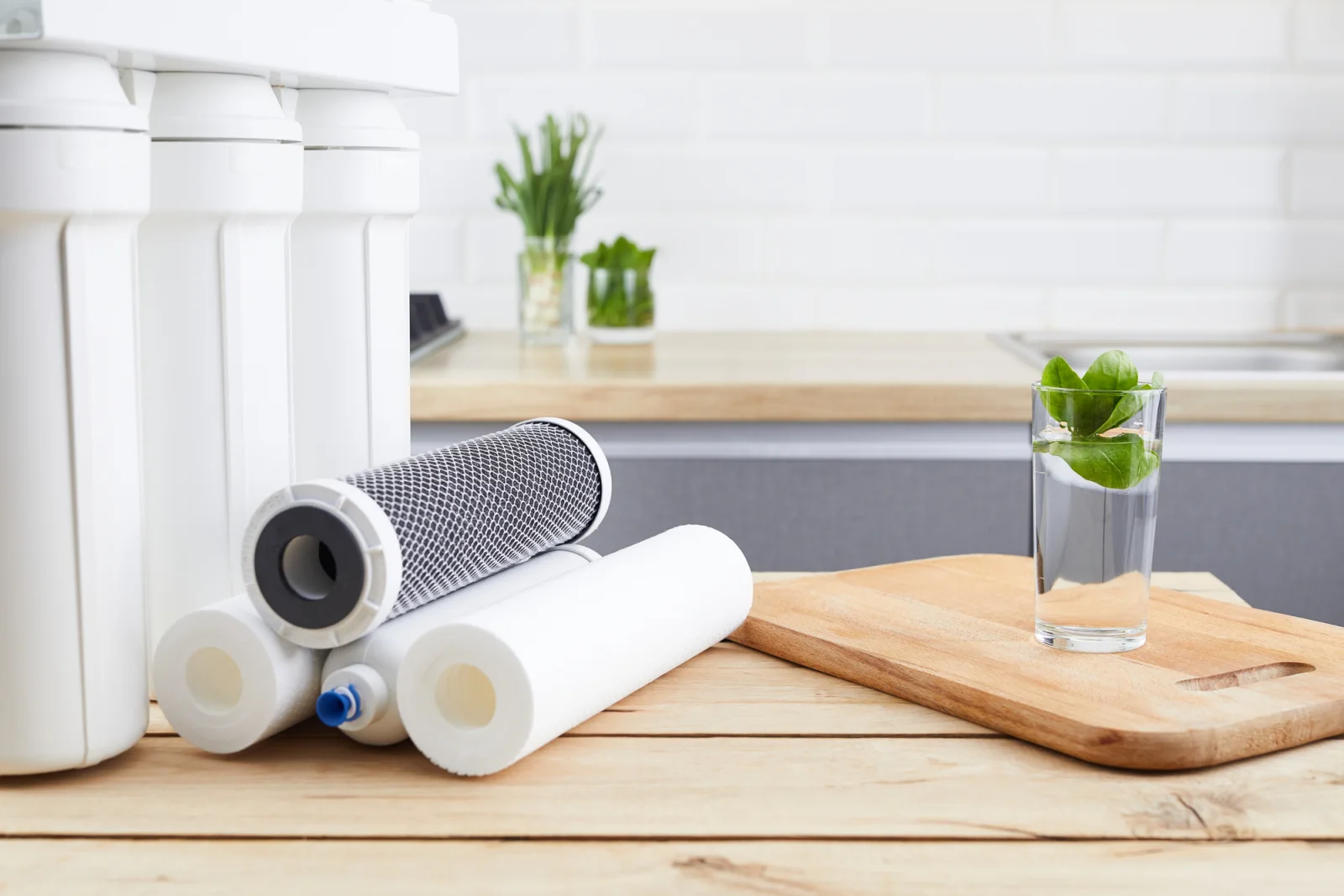
Direct answer: Change or service a whole-house water filter at the interval, treated-gallon limit, pressure differential, or other trigger stated for the exact model—whichever the manufacturer says controls. There is no reliable universal schedule. Cartridge type, media, incoming sediment, household demand, pressure, and the model’s certified claim can all change when service is due.
A maintenance plan should begin with the owner’s manual and model number, not a generic reminder from the internet. If the equipment label is unreadable or the filter was already installed when you bought the home, identify the housing, valve, cartridge, and media before ordering parts or opening the system.
Build the schedule from the equipment record
Create one record for every treatment stage. A sediment prefilter, carbon cartridge, backwashing media tank, ultraviolet unit, and softener are separate devices even when they were sold as one package. Each can have different parts, limits, and procedures.
| Record this | Why it matters |
|---|---|
| Manufacturer, model, and serial number | Similar-looking housings may use different cartridges, seals, or pressure limits |
| Treatment stage and stated purpose | Prevents replacing the wrong component or assuming one stage handles every concern |
| Manual revision and certified product listing | Connects maintenance to the current instructions and supported claim |
| Calendar, gallon, and pressure triggers | Shows which service condition applies to the model |
| Correct replacement part number | A physically compatible cartridge may not preserve the original performance claim |
| Baseline inlet and outlet pressure | Makes later pressure-drop comparisons useful |
| Last service date and meter reading | Provides a defensible starting point for the next service |
| Bypass, shutoff, drain, and leak-sensor locations | Reduces guesswork during planned service or a leak |
Keep invoices, commissioning notes, photos, and replacement labels with this record. For systems chosen to support a specific reduction claim, verify the exact replacement component in the manufacturer’s documentation or certifier’s listing. Our guide to water filter certifications explains why a standard number or certification logo alone is not enough.
A practical maintenance schedule without guessing an interval
Use event-based checks around the manufacturer’s required service dates:
After installation or professional service
- Confirm the bypass is in its normal service position.
- Record clean-filter inlet and outlet pressure while water is flowing under a repeatable household condition.
- Check housings, unions, valve connections, drains, and the floor below the equipment for moisture.
- Save the part numbers and the next manual-defined service trigger.
- Verify that flushing, startup, and any post-service sampling required by the manufacturer were completed.
During routine owner checks
- Look for active drips, rust staining, cracked housings, wet insulation, or water near electrical equipment.
- Notice changes in shower flow or pressure when multiple fixtures run.
- Note a return of the original taste, odor, color, or particle concern, while remembering that symptoms alone cannot establish water safety.
- Review any gallon meter, pressure gauges, indicator lights, or controller alerts supplied with the system.
- Confirm the installation area remains protected within the model’s allowed temperature and environmental conditions.
When a manual-defined trigger is reached
Use the named replacement part and follow the exact shutdown, depressurization, opening, seal inspection, lubrication, sanitation, flushing, and restart procedure. If those steps are absent, unclear, or beyond the owner’s instructions, use qualified service rather than improvising.
Pressure drop and reduced flow
Declining flow can be a sign that a cartridge is loading, but it can also come from a partially closed valve, municipal supply change, plumbing restriction, failed pressure regulator, clogged aerator, or another treatment stage. Compare inlet and outlet pressure under the same flowing condition used for the baseline. Static pressure with every fixture closed does not show how the system behaves under demand.
Do not wait for near-total flow loss if the manual sets an earlier differential-pressure limit. Likewise, do not replace a cartridge solely because one faucet feels slow without checking whether the restriction is local to that fixture.
If pressure loss rises unusually fast, investigate source-water events, well or plumbing problems, upstream equipment, and whether the prefilter is too fine. Repeated replacement may treat only the symptom.
Cartridge and media service are different jobs
A cartridge system usually involves replacing a contained element and inspecting the housing and seal. A media tank may rely on backwashing, an automatic valve, a distributor, and a defined media service life. “Whole-house filter” does not tell you which procedure applies.
For cartridge work, follow the housing instructions. A pinched O-ring, dirty sealing surface, cross-threaded sump, incompatible lubricant, or over-tightened housing can cause a leak. Discoloration does not reveal whether rated capacity has been reached.
For tank systems, review controller time, backwash settings, drain flow, power, bypass position, and media-specific instructions. Do not change programming or add treatment chemicals because another brand’s manual recommends it. The valve, media quantity, bed expansion requirement, and drain configuration are model-specific.
Sanitizing and restart
Sanitizing is not a one-recipe task. The permitted chemical, concentration, contact procedure, component removal, flushing volume, and safety precautions vary. Follow the installed manufacturer’s current instructions exactly. Never mix cleaning chemicals, and never introduce a chemical into equipment unless the manual allows it.
After opening a system, inspect seals and wetted surfaces as directed, reassemble with approved parts, restore pressure gradually, flush as instructed, and recheck for leaks while fixtures are flowing and after they close. If the system serves water used for drinking and the manufacturer requires post-service testing or a specific startup sequence, complete that step before treating the job as finished.
What shortens filter service life?
Real-world service can differ from a printed estimate because of:
- higher-than-expected sediment or another incoming load;
- more water use than the rated-capacity assumption;
- flow above the model’s rated service conditions;
- pressure or temperature outside the stated range;
- the wrong replacement cartridge or media;
- missed backwash, flushing, or pretreatment requirements;
- long stagnation, vacancy, flooding, freezing, or plumbing work;
- a source-water change that the original system was not selected to address.
Houston homeowners should identify the exact public water system or private well serving the property before interpreting a sudden change. The City of Houston report applies to its system, not automatically to every address described as “Houston.” A current report or targeted water testing can help separate a treatment-equipment problem from a water-source or premise-plumbing question.
When to stop and request service
Shut off or bypass the system according to its instructions and seek help for an active leak, cracked pressure vessel, damaged wiring, uncontrolled drain flow, repeated pressure loss, unexplained water-quality change, or a service procedure outside the owner’s manual. Bring the model information, service log, pressure observations, photos, and the original treatment goal when you contact a listed provider.
If replacement is being considered, compare it with the intended function of modern whole-house water filtration. A new system should be selected from current water evidence and household flow—not simply matched to the old tank’s dimensions.
Publisher disclosure: Water Filtration Houston is an independent publisher and provider-matching service, not the company that performs installation. Provider availability, equipment, installation requirements, credentials, warranty terms, and price must be confirmed directly with the selected provider.
Frequently asked questions
How often should I change a whole-house water filter?
Follow the exact model’s stated calendar, gallon, pressure-differential, or performance trigger. Use the earliest controlling limit specified by the manufacturer. A generic number may be too early for one system and dangerously late for another.
Can I wait until the water tastes or smells different?
No. Taste and odor may signal a change, but they are not reliable safety tests and may appear after a model’s rated capacity or service condition has already been exceeded. Scheduled maintenance still applies.
Does a dark cartridge always mean it has failed?
Not necessarily. Appearance may show captured material, but it does not establish remaining capacity, pressure loss, or performance for a named claim. Use the manual’s triggers and operating data.
Should the housing be sanitized every time a cartridge is changed?
Use the exact manufacturer’s procedure. Some manuals pair sanitation with specified service events, but the approved chemical and steps differ. Do not copy a bleach recipe from an unrelated system.
What should I check after filter replacement?
Confirm correct part placement, bypass position, gradual repressurization, required flushing, normal flow, and no leaks at housings or fittings. Record the service date, meter reading, parts, and new pressure baseline.