Houston’s public water is regulated, but “what is in Houston tap water” depends on the system, report year, source, distribution, and household plumbing. Start with the correct annual report, separate aesthetic changes from safety questions, and test at the tap when an address-specific concern cannot be answered by utility data.
Use the Houston-area Consumer Confidence Report index to match Houston Public Works, Sugar Land, or City of Katy records to their official reports and public water system IDs.
What the current Houston report establishes
Houston Public Works’ current 2025 Water Quality Report covers January through December 2025. It reports on six City distribution systems: Main System, Kingwood, Willow Chase, District 73, District 82, and Belleau Woods. The report says Houston’s systems are recognized by the Texas Commission on Environmental Quality as “Superior Water Supply Systems,” TCEQ’s highest public-utility rating.
That rating and the annual report are important evidence; neither is a personalized test of a kitchen faucet. The report also states that drinking water may contain small amounts of contaminants without their presence necessarily indicating a health risk. Results must be read against applicable limits, monitoring locations, dates, units, and footnotes.
The 2025 report should be read in full rather than reduced to a slogan. Its Main System section lists a May 2025 single-sample turbidity exceedance and a September 2025 chlorite monitoring/reporting violation. Listing those report entries does not establish a current tap-water hazard. It does show why a homeowner should review the compliance and violation sections—not just detection tables—and contact Houston Water or TCEQ for current status when a historical entry raises a question.
Houston has more than one source and system
The City report describes a regional operation using surface water from the Trinity River/Lake Livingston and San Jacinto River/Lakes Conroe and Houston, plus groundwater from the Chicot and Evangeline aquifers. In 2025, the Main System reported a 90.3% surface-water and 9.7% groundwater mix. Kingwood, Willow Chase, District 73, and District 82 reported 100% groundwater. Belleau Woods reported purchased water from the City of Humble with a mixed surface-water and groundwater source.
| Question to answer | Best evidence | What it can tell you | What it cannot tell you |
|---|---|---|---|
| Who supplies the property? | Current water bill or utility account | Utility or district name | Current tap chemistry by itself |
| Which City report section applies? | Public water system name and ID | Correct annual system table | Conditions in household plumbing |
| What was detected systemwide? | 2025 report tables and footnotes | Reported range, average, compliance context, and sampling year | A real-time fixture result |
| Why did taste or odor change? | Utility notices plus source information | Possible systemwide or seasonal context | Proof that water is safe or unsafe |
| Is there an address-specific concern? | Properly collected tap sample | Conditions at the sampled place and time | Future conditions or unsampled fixtures |
A Houston mailing address may be served by a municipal utility district or another provider rather than one of the six City systems. TCEQ advises consumers to use their water system’s annual Consumer Confidence Report. Its drinking-water quality guidance can help residents understand where to look.
Taste, odor, and color are not safety tests
Houston Public Works explains that reservoir-sourced water can develop earthy or musty taste and odor associated with geosmin and MIB from naturally occurring algae. For well-sourced water, the City identifies naturally occurring hydrogen sulfide, sulfur, iron, and manganese as possible contributors to aesthetic changes. Source proportions can shift during operating conditions and demand.
These are clues, not universal explanations. An earthy smell does not identify a concentration, and clear water does not prove that every regulated substance is absent. The City’s taste, odor, and color guidance directs customers with concerns to Houston Water. A change limited to one fixture may originate in that fixture, its drain, or nearby plumbing.
Use this triage sequence:
- Compare hot and cold water and more than one fixture.
- Ask whether neighbors on the same system notice the same change.
- Review current Houston Water notices and the annual report.
- Contact 311 or the utility when the change is sudden, widespread, or unexplained.
- Follow any official advisory rather than relying on a home filter as a substitute.
- Test the water when the concern is address-specific or requires a measured answer.
Household plumbing can change the question
The utility is responsible for providing water through its system, but service-line and premise-plumbing materials matter at the tap. Houston’s 2025 report says lead in drinking water is primarily associated with service lines and home-plumbing materials. It also notes that lead levels can vary over time and that one tap result is a point-in-time observation.
This distinction matters in older properties, after plumbing work, or where the service-line material is unknown. Boiling does not remove lead. The report directs residents to Houston’s service-line inventory and provides a City contact for lead concerns. Anyone considering treatment for lead should verify a model-specific claim from an ANSI-accredited certifier and follow the device instructions; a generic “water filter” label is not enough.
Water heaters, stagnant branches, faucet components, and poorly maintained treatment devices can also influence what a resident sees or tastes. An annual system report cannot diagnose those conditions. It is the correct first layer of evidence, followed by property information and testing when needed.
How to read a Consumer Confidence Report
Do not scan only for a familiar contaminant name. Read each row with its definitions and notes:
- System and reporting year: Confirm the report applies to the property and note the calendar period.
- Units: Parts per million and parts per billion differ by a factor of one thousand.
- MCL and MCLG: The Maximum Contaminant Level is the enforceable limit; the Maximum Contaminant Level Goal is a non-enforceable public-health goal.
- Range versus average: A minimum, average, maximum, or locational running annual average answers a different question.
- Sampling location: Plant, distribution-system, and customer-tap results should not be treated as interchangeable.
- Footnotes: Reduced monitoring and prior-year data can appear in a current report.
- Violations and notices: Read these sections for compliance context and the utility’s explanation.
TCEQ describes a Consumer Confidence Report as a readable summary of information the water system collects to comply with federal and state requirements.
When household testing makes sense
Testing is useful when a question is specific to the property: unknown service-line material, a private well, persistent discoloration at one home, changes after plumbing work, or a treatment decision that requires incoming hardness, iron, manganese, or another design input. Field strips and meters can screen some characteristics, but they are not interchangeable with certified laboratory analysis.
Choose the analyte before choosing the test. Use proper collection and a suitable laboratory for health-related conclusions. A sales demonstration is not comprehensive laboratory testing.
The CDC’s filter-selection guidance recommends reviewing the public report or testing the water, then choosing treatment for the substances of concern. It also warns that taste, odor, and appearance are not reliable indicators of safety and that treatment systems require maintenance.
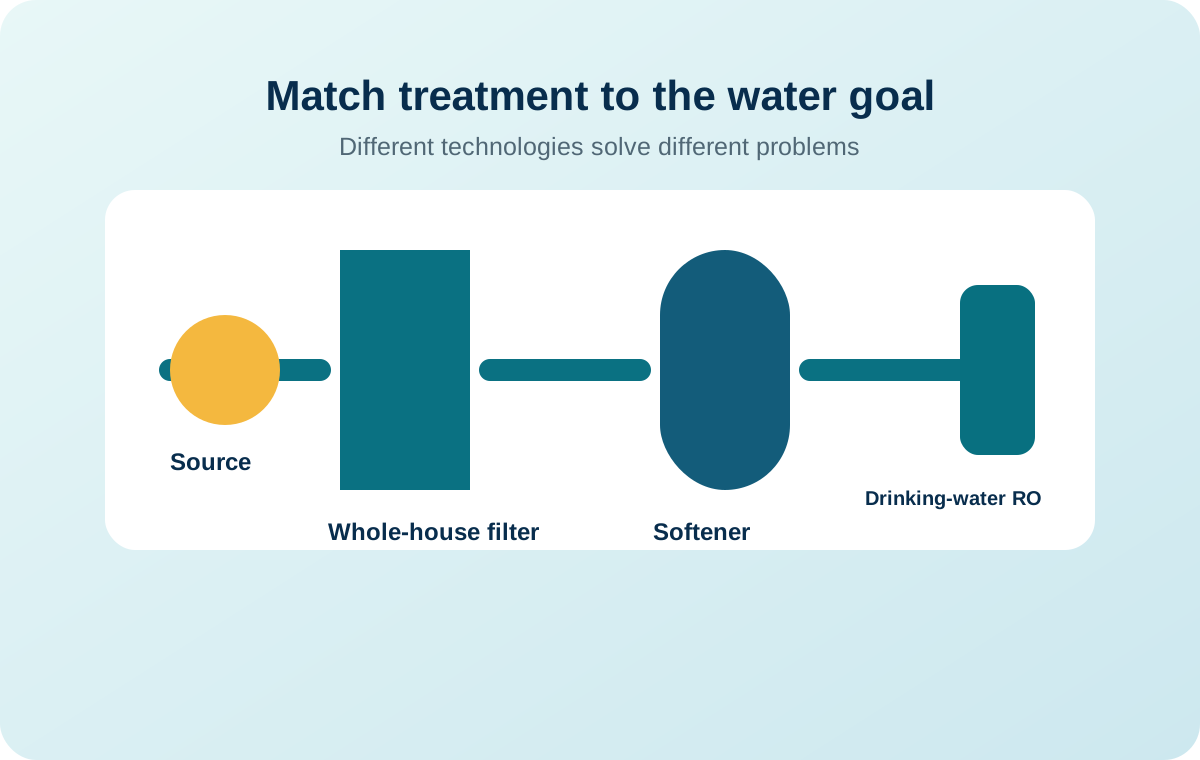
Match treatment to a verified goal
Hardness, disinfectant taste, sediment, lead, and dissolved substances are different questions. The Houston water hardness guide addresses mineral results without turning one system number into a citywide claim. The page addressing is Houston tap water safe explains why regulation, advisories, and premise plumbing matter. Use water testing when the report cannot resolve an address-specific concern.
A point-of-entry system treats incoming water before distribution through the home, but performance depends on the exact media, flow, capacity, and certification. Review whole-house water filtration only after defining the treatment goal. Do not assume carbon softens hardness, that a softener removes regulated contaminants, or that any device removes “everything.”
Limits and current service status
This page summarizes official sources but is not a real-time advisory, laboratory result, or medical recommendation. Annual reports describe completed reporting periods. Utility operations, advisories, and property conditions can change after publication. Follow Houston Water, TCEQ, and public-health instructions during an active notice.
Publisher disclosure: Water Filtration Houston is an independent publisher and provider-matching service, not the company that performs testing or installation. Provider coverage, testing scope, equipment, credentials, warranty terms, and price must be confirmed directly with the selected provider.
Frequently asked questions
Does Houston publish a water-quality report every year?
Yes. Community water systems provide annual Consumer Confidence Reports, and Houston Public Works maintains current and prior reports online. The current City report covers 2025 and includes separate sections for six distribution systems.
Can the annual report tell me what is at my kitchen tap today?
Not exactly. It reports system monitoring over a defined period. A tap can also be affected by service-line material, premise plumbing, stagnation, a water heater, or an existing treatment device. Address-specific concerns may require a properly collected sample.
Does bad taste mean Houston water is unsafe?
No. Taste and odor can have aesthetic causes, and pleasant-tasting water is not proof of safety. Review official notices, identify whether the issue affects hot or cold water and multiple fixtures, contact the utility when appropriate, and test for the actual concern.
Should I buy a whole-house filter after reading a detection table?
Not automatically. A detection does not by itself define risk or the correct treatment. Compare the result with its limit and context, determine whether the issue exists at the property, and verify that a specific model is certified or otherwise substantiated for the intended reduction under the home’s conditions.
Sources
- City of Houston, 2025 Water Quality Report, January–December 2025 system, source, monitoring, and compliance information.
- Houston Public Works, Drinking Water Quality Reports, annual-report index.
- Houston Public Works, Drinking Water Taste, Odor and Color, local aesthetic and source-water explanations.
- TCEQ, How Is My Drinking Water Quality?, Consumer Confidence Report guidance.
- CDC, About Choosing Home Water Filters, report review, testing, selection, and maintenance guidance.