Houston water-treatment service guide

Water Softeners and Filtration in Katy, TX

Plan Katy water softening, filtration, RO, and testing by confirming the utility, current report, measured need, and exact model claims.

Quick answer: Choosing a water softener or filter for a Katy property starts by identifying the actual water supplier, not by relying on “Katy” in the mailing address. The City of Katy says its municipal system operates six water plants and seven wells drawing groundwater from the Gulf Coast Aquifer, but the City also warns that a Katy mailing address does not necessarily mean the property is in City jurisdiction. Confirm the utility, read its current report, and measure the property before selecting or sizing equipment.

Katy is a place where the jurisdiction question changes the entire water-treatment conversation. A homeowner may reasonably say “City of Katy” when describing a postal address, school community, or general area, yet receive a bill from a different public water system. City Water Department facts are useful only after City water service is established for the address. A municipal utility district or another supplier may publish a different report, use different sources, issue different notices, and direct residents to a different authority for plumbing or installation questions.

This is a prelaunch planning resource. Katy installation territory has not been verified for this page, and online request routing is inactive. The page does not represent Katy projects, reviews, installed prices, appointment availability, or response times. The contact page shows current contact options; an online submission is not a booking and does not confirm coverage.

First, confirm which “Katy” applies

The City of Katy’s utilities page explicitly states that a Katy mailing address does not mean a property is within City limits. That warning should come before any statement about Katy water hardness, source, or treatment.

Use this sequence:

  1. Check the supplier name and account information on a recent water bill.
  2. If the bill is unavailable, use the City’s resident/jurisdiction resources and any district documents associated with the property.
  3. Find the current Consumer Confidence Report for that exact public water system.
  4. Check current notices, planned flushing, main work, or other utility updates.
  5. If the property uses a private well, do not apply municipal-system data; build a well-appropriate testing plan.
  6. Keep installation territory separate and verify it directly before work is scheduled.
Identity question Evidence to use Common mistake
Is the property inside City of Katy jurisdiction? City jurisdiction tool or direct City confirmation Treating the postal city as the municipal boundary
Who supplies the tap? Current bill, district record, or utility confirmation Applying City Water Department facts to every Katy address
What did the system monitor? Current report and utility notices Treating an annual report as a sample from one home
What is happening at this property? Fixture checks and fit-for-purpose testing Diagnosing from taste, spots, or a city name alone
Is a provider available? Direct provider territory confirmation Assuming inclusion on this noindex page means coverage

The broader Houston-area service guide explains the same distinction across the region. In Katy, however, the City’s own mailing-address warning makes it especially important.

What the City of Katy source information establishes

The City Water Department states that it operates and maintains six water plants and seven water wells drawing groundwater from the Gulf Coast Aquifer. The Department also provides an annual water-quality report hub. Those are the right starting sources for addresses confirmed to be on the City system.

They do not establish one permanent hardness number for every City customer, much less every Katy-area home. No hardness value is published on this page because one has not been verified for the relevant address, system, date, and method. Groundwater source context may justify asking about minerals, but it does not justify programming a softener from an invented “Katy average.”

An annual report answers a different question from a property test. It summarizes required public-system monitoring over a stated reporting period. It may help identify disinfectant context, regulated detections, ranges, and source information. It does not account for every condition in a home’s service line, water heater, faucets, filters, or periods of stagnation. Always read the report’s units, dates, locations, and notes rather than copying an isolated number.

Current utility advisories take priority over evergreen treatment copy. If taste, odor, color, or pressure changed suddenly, first ask whether the condition affects hot and cold water, one fixture or every fixture, and neighboring properties. Review utility notices before purchasing equipment in response to a temporary event.

Match the concern to the right pathway

A softener, whole-house filter, and reverse-osmosis system solve different problems. A bundle may include more than one stage, but each stage still needs a defined purpose.

Scale and measured hardness

For mineral residue, soap behavior, or scale consistent with calcium and magnesium, begin with the utility report and a current hardness measurement at the property. Then review water-softener systems. Ion exchange can reduce hardness minerals, but a softener is not a general contaminant filter. Ask how raw hardness, household use, peak flow, resin volume, regeneration settings, and salt efficiency were used in the recommendation.

A whole-home taste, odor, sediment, or named reduction goal

Use the whole-house water-filtration guide when the goal applies to incoming water across the home. The target must be specific: sediment management, an aesthetic chlorine-related concern, or a named substance supported by evidence. “Whole house” only describes point-of-entry placement. It does not establish which substances a system reduces or how long the media remains effective.

Drinking and cooking water at one fixture

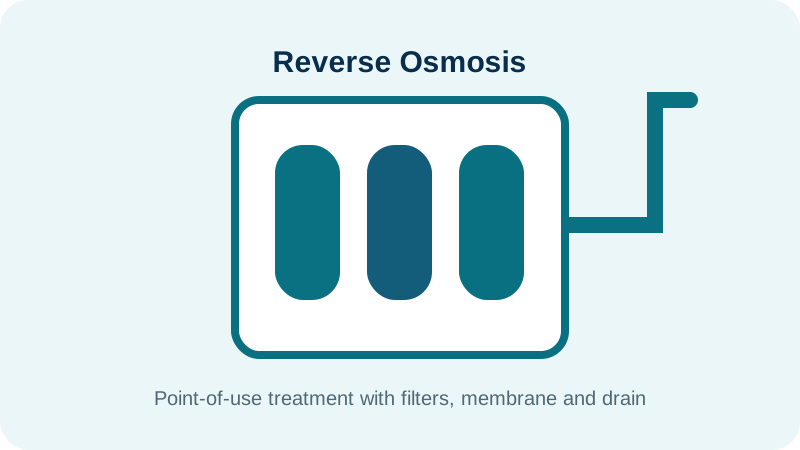
Use the reverse-osmosis systems guide when the goal is point-of-use treatment for drinking and cooking water. Compare the complete system’s certified claims, production under stated conditions, storage or tankless delivery, prefilters, postfilters, reject-water characteristics, pressure requirements, sanitation, and replacement plan. Under-sink RO does not treat showers, laundry, appliances, or every tap.

An unresolved property-specific question

Use water testing when a report cannot answer the decision. A field hardness or disinfectant screen can help with equipment planning, but it is not interchangeable with accredited laboratory analysis for health-related contaminants. Select methods, sample location, preservation, and laboratory scope based on the question. Avoid broad “test everything” packages that do not explain methods or decision thresholds.

Diagnose before buying

Visible or sensory symptoms should organize investigation, not serve as a product prescription.

  • Only hot water is affected: inspect the water heater and hot-water pathway before blaming the public supply.
  • One faucet is affected: check the aerator, fixture, local supply line, and any point-of-use device.
  • Every hot and cold tap changed suddenly: review utility notices and ask the supplier about distribution work or flushing.
  • White spotting or scale is recurring: measure current hardness before softener sizing; spotting does not prove a health risk.
  • Pressure dropped after an existing filter: inspect cartridges, valves, bypass position, and pressure drop before upsizing equipment.
  • Taste or odor is the concern: identify timing, hot versus cold, and the actual disinfectant context; sensory observations do not identify every compound.

Do not describe softened water, filtered water, or RO water as universally “safer” without a measured concern and a substantiated model claim. Public-system compliance information, private plumbing conditions, and treatment performance are separate evidence layers.

Size a Katy water softener from measured inputs

A useful softener proposal should show its work. At minimum, ask for:

  • the measured hardness value, units, sample date, and sample location;
  • whether iron or other conditions were tested and how they affect the design;
  • household occupancy and realistic daily water use assumptions;
  • peak simultaneous demand from showers, tubs, appliances, and other fixtures;
  • incoming pipe size and available pressure;
  • resin volume and usable capacity at the proposed salt dose;
  • expected regeneration frequency and reserve logic;
  • bypass, drain, air gap, overflow, and electrical requirements;
  • installation location and weather protection; and
  • which outdoor or irrigation lines remain untreated.

A high advertised capacity number is not enough. Capacity changes with resin volume, salt setting, raw hardness, and operating assumptions. A unit that looks large in a brochure can still create pressure or regeneration problems if service flow and programming are ignored.

Do not use a guessed Katy hardness value to complete this calculation. If the source changes or the utility report shows variability, decide how the current property measurement will be verified at startup and revisited later.

Compare filters by exact model and claim

Broad terms such as “premium filtration,” “purifier,” “chemical-free,” or “removes contaminants” are not measurable specifications. Ask the seller to name the complete model, not just a component or media brand.

For any reduction claim, verify:

  1. the exact model in an independent certifier’s current listing;
  2. the applicable standard;
  3. the named contaminant or performance claim;
  4. rated capacity or service life;
  5. flow, pressure, temperature, and water-quality conditions;
  6. required prefilters and replacement schedule; and
  7. whether the certified listing covers the complete system or only one component.

A material-safety standard does not automatically establish contaminant reduction. Likewise, a carbon tank may help with a specific aesthetic goal only when media type, contact time, service flow, and source conditions support that use. A reduction percentage is not a promise of zero concentration or suitability for every source.

For health-related questions, use current official guidance and testing. Do not infer that a taste, odor, or trace mention in a report creates an emergency, and do not let fear-based claims replace measured evidence.

Installation scope and authority

The correct authority can depend on the property’s actual municipal, county, district, and plumbing jurisdiction. A Katy mailing address alone does not resolve permits, inspections, backflow, drain, air-gap, or contractor requirements. Ask the applicable authority having jurisdiction about the proposed scope; do not accept a blanket claim that “Katy does not require a permit.”

A comparable written scope should state:

  • exact equipment and treatment stages;
  • main-line tie-in location and pipe materials;
  • bypass and isolation valves;
  • drain, air-gap, backflow, and discharge details;
  • electrical work, if any;
  • protection from weather, flooding, and physical damage;
  • startup settings and post-install checks;
  • included cleanup and removal;
  • exclusions and owner responsibilities; and
  • manufacturer, parts, media, labor, and workmanship warranty terms.

No local installer qualifications or availability have been verified for this page. If a provider path is introduced later, confirm identity, applicable license or exemption, insurance, territory, and permitting responsibilities directly. The existence of a Water Department page proves nothing about a private company.

Maintenance belongs in the buying decision

Ask for a multi-year maintenance schedule before choosing a system. “Low maintenance” still needs a list of owner tasks, consumables, performance checks, and end-of-life conditions.

A softener plan may include salt replenishment, brine-tank inspection and cleaning, bridging checks, setting reviews, leak checks, and eventual resin or component service. A whole-house cartridge system needs exact replacement part numbers, capacity or pressure-drop triggers, safe depressurization steps, housing and O-ring care, and sanitation guidance. A media tank may backwash automatically but still needs performance monitoring and eventual media replacement. An RO system generally needs prefilter and postfilter changes, membrane performance checks, sanitation, leak inspection, and confirmation that drain and storage components work correctly.

Compare proprietary and commonly available consumables. Request current written prices, but treat them as proposal-specific rather than a Katy market average. Clarify which maintenance preserves warranty coverage, what labor is excluded, who records service, and how treated-water performance will be verified.

How to compare proposals without invented Katy pricing

This site has not verified comparable local quotes, so it does not publish a Katy average. Equipment-only retail prices, installed under-sink systems, dealer softener packages, and whole-house multi-stage systems are not comparable categories.

Normalize proposals by asking each provider to price the same documented scope:

  • complete model numbers and treatment stages;
  • evidence and calculations used;
  • equipment, labor, materials, permit, and inspection allowances;
  • plumbing changes, drain, power, and site preparation;
  • startup, programming, and post-treatment testing;
  • removal and disposal;
  • consumables and expected maintenance;
  • warranty coverage and exclusions; and
  • optional work separated from required work.

A cheaper proposal may simply omit plumbing, testing, media, permits, or service. A more expensive proposal is not automatically better. The useful comparison is line by line, tied to the same measured goal.

Prelaunch service status

Katy appears here because it is a first-wave editorial market within the broader Houston water-treatment service-area hub, not because provider coverage has been established. Matching is inactive. There are no verified Katy projects, reviews, territories, prices, schedules, response times, licenses, or insurance details to publish.

If you want to ask an editorial question or register interest, use contact. Submission does not book an assessment, select or recommend a provider, confirm utility jurisdiction, create a quote, or require you to hire anyone.

Frequently asked questions

Does a Katy mailing address mean I receive City of Katy water?

No. The City’s utilities page explicitly warns that a Katy mailing address does not mean the property is inside City jurisdiction. Check a recent bill or use the City’s jurisdiction resources to identify the actual supplier before using City water information.

What is the City of Katy’s water source?

For the City system, the Water Department says it operates six water plants and seven wells drawing groundwater from the Gulf Coast Aquifer. That statement applies only after the address is confirmed to be served by the City system.

How hard is Katy water?

There is no verified property-specific value on this page, and a Katy postal label is not enough to choose one. Find the correct utility report and measure current hardness at the home before selecting or programming a softener.

Do I need a softener, whole-house filter, or reverse-osmosis system?

It depends on the measured goal. A softener addresses calcium and magnesium hardness; a whole-house filter needs a named point-of-entry claim; and typical under-sink RO treats drinking and cooking water at one fixture. One device should not be represented as doing all three jobs unless the complete system documentation supports it.

What should I verify in a water-treatment model?

Verify the complete model number, treatment mechanism, exact certified claim, rated capacity, operating conditions, flow and pressure data, required consumables, maintenance schedule, and warranty exclusions. A logo or standard number by itself is not a complete performance claim.

Can I book Katy installation through this website now?

No. Water Filtration Houston remains in prelaunch, Katy installation territory has not been confirmed for this page, and online request routing is inactive. A contact submission does not confirm territory, availability, price, schedule, or installation.

Sources

Online request status

Online consultation requests are not active yet.

Water Filtration Houston is accepting direct phone conversations while the online request workflow, consent language and delivery checks are completed.

Call the company directlyNo personal-information form is displayed hereThis panel does not submit a request
Call (281) 768-4021