Quick answer: A Missouri City mailing address is not enough to choose a water softener or filter. First identify the public water system that bills or serves the property, then obtain that system’s current Consumer Confidence Report and measure the condition at the relevant tap. Official Missouri City materials document distinct service areas, including Mustang Bayou and City South, and the city separately maintains a municipal utility district operator directory. Those facts make exact utility resolution the first decision—not a citywide treatment assumption.
This is a prelaunch planning page. It does not confirm Missouri City installation territory, and online request routing is inactive. The purpose is to help a property owner assemble the evidence needed to compare a water softener, whole-house filtration system, reverse-osmosis system, or a narrower response to a measured condition.
Start with the system, not the city name
Missouri City’s official Consumer Confidence Report hub is the right first stop, but the correct report depends on the address. The city publishes separate reports for named service areas. Its 2024 Mustang Bayou report identifies public water system PWS ID 0790207. The 2024 City South report describes a different source arrangement: City South receives groundwater from Sienna Municipal Utility District No. 1 and surface water from Missouri City.
That distinction matters before equipment enters the discussion. Two properties may both use “Missouri City, TX” in a postal address while receiving water through different utility structures, source combinations, treatment operations, or distribution systems. A report for Mustang Bayou should not be substituted for City South, a separate MUD, or another public water system merely because all are associated with Missouri City.
The city’s official MUD operator directory reinforces this point. It lists municipal utility districts and operator contacts so residents can resolve who operates a system. The official search materials identify Quail Valley Utility District as the operator contact associated with the Mustang Bayou system. An operator listing is useful for resolving jurisdiction and requesting current information; it is not evidence that every nearby address receives the same water.
Use the service-area planning hub for the broader geographic framework, but verify the individual property independently.
A proof-gated Missouri City workflow
Follow this order to avoid matching equipment to the wrong evidence.
- Read the water bill. Record the exact utility, district, or public water system name shown. Do not shorten it to “Missouri City water.”
- Confirm the address with the utility or operator. If the bill, lease, closing papers, or seller information is unclear, use Missouri City’s MUD operator directory or the contact information in the applicable official report.
- Record the PWS ID when available. Names can be similar; a public water system identification number is a more precise reference. Mustang Bayou’s 2024 report lists PWS ID 0790207.
- Download the current report for that exact system. A 2024 report is useful historical context, but it should not replace a newer report after the official hub publishes one.
- Check current notices. A Consumer Confidence Report summarizes a reporting period. It is not a live advisory feed, and current utility notices take priority for temporary events.
- Define the property-level goal. Separate appliance scale, spotting, sediment, taste, odor, a named substance, and drinking-water preferences into distinct questions.
- Measure where the question occurs. Source reports and property measurements answer different questions. Use water testing when an issue requires a current measurement at the home or a particular tap.
- Only then compare equipment. Require the proposal to state the exact model, intended purpose, flow assumptions, installation boundaries, replacement schedule, maintenance, and exclusions.
This sequence keeps an official report in its proper role: source and monitoring context for the identified public system. It prevents a compliance table, source description, or city name from being converted into a product prescription.
What the Mustang Bayou and City South reports establish
The official documents establish useful system facts, but those facts have limits.
Mustang Bayou
The 2024 Mustang Bayou Consumer Confidence Report is tied to PWS ID 0790207. That identifier helps distinguish the report from other systems in and around Missouri City. The city’s official operator search also points to Quail Valley Utility District as the operator contact. For a property believed to be in this service area, the report title, PWS ID, bill, and operator confirmation should agree before its tables are used as context.
City South
The 2024 City South report states that the service area receives groundwater from Sienna MUD No. 1 and surface water from Missouri City. This is a source description for that named service area, not a formula for the exact blend at every tap on every day. It also does not authorize applying City South information to a property served by a different district.
The mixed-source description is a reason to ask precise questions: Which report currently applies? Has the listed source arrangement changed? Is the concern at the entry point, at one fixture, or only on hot water? What does a current property sample show? It is not a reason to infer hardness, total dissolved solids, a contaminant concentration, or a treatment need without measurement.
Disinfectant questions require utility confirmation
Missouri City publishes an official chloramine fact sheet. Its existence makes disinfectant identity a legitimate item to verify with the exact serving utility. It does not justify assuming that every Missouri City-addressed property has the same disinfectant, residual, or treatment conditions.
If the current utility information confirms chloramine for the property’s system, put that fact into the written design criteria for any whole-house proposal. Ask the seller to identify the exact equipment model and the operating assumptions behind any disinfectant-related performance statement. If the current system instead documents another disinfectant, the proposal should reflect that evidence. A dated municipal fact sheet should not outrank a current report, a current notice, or direct confirmation from the serving utility.
Avoid using taste or odor alone to identify a disinfectant. A household observation can help define where and when a condition occurs, but it cannot resolve the public water system, establish a concentration, or identify every possible cause.
Match the tool to a narrowly stated goal
A strong request begins with a question that can be tested, not with a preferred product name.
| Property question | Evidence to collect first | Appropriate comparison path |
|---|---|---|
| Is mineral scale affecting fixtures or appliances? | Exact utility, current report context, and a current hardness measurement at the property | Review water softener planning only after the measurement is known |
| Is there a whole-home taste, odor, or disinfectant objective? | Serving system, current disinfectant information, location and timing of the observation | Compare whole-house filtration against the documented objective |
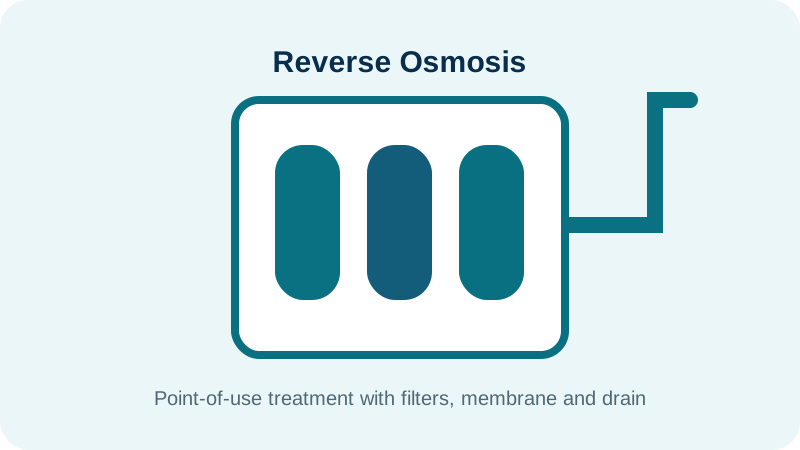
| Is the goal limited to drinking and cooking water? | Current sample from the intended tap and a clearly named target | Review reverse-osmosis systems and exact model documentation |
| Is the concern a named substance? | Applicable official report plus properly selected property testing | Begin with water testing, not a generic filter bundle |
| Does the issue occur at only one fixture or only on hot water? | Paired observations or samples that isolate the location | Investigate premise plumbing or the appliance boundary before proposing whole-house equipment |
A softener question should stay focused on measured hardness and operating needs. A filtration question should name the substance or aesthetic condition to be addressed. A point-of-use question should identify the tap and intended use. Combining every concern into “bad water” makes proposals harder to verify and encourages unsupported package selling.
How to read an official report without overreaching
A Consumer Confidence Report tells readers about a public system, its sources, required monitoring, and results for a stated period. It can help identify which questions deserve follow-up. It cannot by itself describe the current condition inside a particular home.
Do not turn a detected-contaminant table into a treatment recommendation. Do not assume that a reported system result is the concentration at today’s kitchen tap. Distribution conditions, service lines, building plumbing, water heaters, fixture materials, occupancy patterns, and sampling timing can change the property-level question. Conversely, a household symptom does not prove that the public system caused it.
Keep three records separate:
- System evidence: the current official report and notices for the exact PWS.
- Property evidence: samples, observations, plumbing history, and where the issue occurs.
- Product evidence: exact-model documentation for the named performance goal and operating conditions.
A credible comparison connects all three without claiming that one substitutes for another.
Questions to put in every written proposal
Once the utility and goal are resolved, use a common scope so competing proposals can be compared fairly:
- What exact model or model combination is proposed?
- Which measured condition is each component intended to address?
- What inlet water assumptions were used?
- What service flow and peak demand were assumed for the property?
- Where will equipment, bypasses, drains, and any point-of-use faucet be installed?
- Which fixtures or lines are included and excluded?
- What routine maintenance, media, salt, filters, or sanitation steps are required?
- What triggers replacement or regeneration?
- What happens to pressure, wastewater, or available space under the proposed design?
- Which claims are conditional, and what would invalidate them?
- What is included in the written price, and what remains outside the scope?
No local price range is stated here because a verifiable Missouri City price requires an actual property scope, equipment selection, installation conditions, and a current quote. A city name is not a price input.
Before using the contact page
Prepare a one-page evidence packet containing the service address, exact utility name, PWS ID if known, link or date for the current report, recent notices, the specific concern, where and when it occurs, and any property measurement. That packet can make a future discussion more precise.
The site’s contact page may be used to review current contact options, but online request routing is inactive and this page does not confirm Missouri City availability, territory, or scheduling. Verify the responsible company, scope, claims, qualifications, and terms before work is scheduled.
Frequently asked questions
Does every Missouri City address receive the same water?
No. Official Missouri City materials publish separate service-area reports and a municipal utility district operator directory. Identify the utility and public water system for the exact property instead of using the mailing city as the system name.
What does PWS ID 0790207 identify?
Missouri City’s 2024 Mustang Bayou Consumer Confidence Report identifies PWS ID 0790207. Use that identifier, the utility bill, and operator confirmation to determine whether the report actually applies to the property.
What is distinctive about the City South source description?
The 2024 City South report says City South receives groundwater from Sienna MUD No. 1 and surface water from Missouri City. That system-level source statement does not reveal the current blend or establish a treatment need at a specific home.
Does Missouri City’s chloramine fact sheet prove my tap water contains chloramine?
No. The fact sheet is an official source to consult, but disinfectant identity must be confirmed for the exact serving system using current utility information. Do not apply one municipal document to every Missouri City mailing address.
Can a Consumer Confidence Report choose a water softener or filter for me?
No. A report provides public-system context for a stated period. Selection still requires the correct system, a defined goal, current property measurement when relevant, and exact-model documentation; a compliance table should not be converted into a treatment prescription.
Can I schedule Missouri City installation through this website now?
No. This prelaunch page does not confirm Missouri City service territory or availability, and online request routing is inactive. The contact page shows current contact options; company details and proposal terms still require direct verification before work is scheduled.