Houston water-treatment service guide

Water Filtration Planning in Richmond, TX

Resolve the exact Richmond water utility, review current official source and PFAS information, and test at the property before choosing treatment.

Quick answer: Do not choose water-treatment equipment from “Richmond, TX” alone. First confirm whether the property is served by the City of Richmond or another public system, then obtain that exact system’s current Consumer Confidence Report and notices. Richmond’s official materials say its surface-water plant supplements groundwater, and its PFAS page says quarterly treated-tap samples were collected over 12 months at all six treatment plants. Those system facts are valuable context, but neither a source description nor a compliance table establishes the present condition or treatment need at one property.

This is a prelaunch research guide. It does not establish Richmond installation territory or availability, and online request routing is inactive. Its purpose is to show what evidence should exist before anyone compares a water softener, whole-house water filter, reverse-osmosis system, or property-specific test plan.

Richmond addresses must be resolved one utility at a time

Richmond is both a place name and a postal address, not a universal water-system label. A property associated with Richmond can be served by the city, a municipal utility district, another public system, a shared or master-metered arrangement, or a private well. The city’s official Water Quality and Consumer Confidence Report pages are authoritative for the City of Richmond system, but they should not be applied to an unconfirmed address.

Begin with a current water bill. Record the full utility name, account information, and any public water system identifier shown. If an owner does not receive a direct bill, ask the property manager, landlord, seller, or closing contact for the serving utility in writing. New developments and boundary areas deserve particular care because the mailing city and service provider may not match.

Once the utility is identified, obtain the newest official report from that utility—not simply the first “Richmond water quality” result found online. Save the report year and URL. Then check current notices separately, because an annual Consumer Confidence Report summarizes a past reporting period and cannot function as a live operational alert.

The service-area planning page provides a broader navigation point, but no geographic link should be treated as proof that a provider or a public water system covers a specific property.

Richmond’s source picture is not a one-word label

The City of Richmond’s official surface-water plant article says the plant supplements groundwater. That statement is important because it rules out the simplistic assumption that “Richmond water” can always be described as only groundwater or only surface water. It also calls for restraint: the article does not provide a permanent, property-level blend percentage for use in equipment sizing.

A supplemental surface-water source can make the source story more complex over time. Operations, demand, maintenance, and other system conditions can affect how source water is supplied within a public system. This page does not infer a day-to-day blend, a hardness value, a total dissolved solids value, or any contaminant concentration from the official article. Those values would require current, applicable evidence.

For a city-served property, ask:

  • Does the newest Consumer Confidence Report still describe the same source arrangement?
  • Does a current utility notice change the immediate instructions?
  • Which treatment plant or distribution context, if any, can the utility confirm for the address?
  • Is the concern present throughout the building, at one fixture, or only on hot water?
  • Is the objective aesthetic, operational, or tied to a named substance?
  • What does a properly selected current property sample show?

For a non-city system, replace the Richmond city sources with that system’s official report and contacts. Do not borrow the city’s plant count, PFAS sampling description, or source statement.

What the official Richmond PFAS page establishes

Richmond’s official PFAS page says the city collected quarterly treated-tap samples over a 12-month period at all six treatment plants. That is a meaningful description of the city’s monitoring approach. It tells a reader the sampling frequency, duration, sample stage, and plant coverage stated by the city.

It does not answer every property-level question. “Treated tap” at a treatment plant is not the same sample location as a kitchen faucet downstream of the distribution system and premise plumbing. The page also should be read in its current official form because PFAS information, regulatory context, and utility reporting can change.

Most importantly, this planning page does not translate Richmond’s PFAS information or any associated table into a recommendation for reverse osmosis, carbon, or another technology. The correct process is:

  1. Confirm that the City of Richmond system serves the property.
  2. Read the city’s current PFAS page and current Consumer Confidence Report together.
  3. Identify the exact PFAS question and the location where an answer is needed.
  4. Determine whether a property sample is appropriate and how it should be collected.
  5. Compare only exact equipment models with documentation relevant to the named goal.
  6. Preserve the conditions, capacity, maintenance requirements, and limitations attached to any performance statement.

A general label such as “PFAS filter” is not a complete scope. Nor does a reported system result guarantee a particular concentration at every tap at all times. Official monitoring is screening context; a current, properly framed property question remains essential.

Build a Richmond decision record before discussing products

A durable record separates facts from assumptions.

Record layer Include Do not substitute
Utility identity Exact biller, public system name, PWS ID if available, and written confirmation “Richmond address”
Official system evidence Current report, current notices, source description, and applicable PFAS page An older report from a different utility
Property evidence Sample location, date, method, units, plumbing history, and symptom pattern A citywide average or a neighbor’s result
Treatment objective Named substance, hardness, taste, odor, sediment, or point-of-use preference “Purify everything”
Product evidence Manufacturer, exact model, stated purpose, operating conditions, capacity, and upkeep A category name or certification logo alone
Proposal scope Flow, tie-in, bypass, drains, power, fixtures, exclusions, verification, and price A verbal package description

This structure prevents an official city fact from being stretched beyond its documented boundary. It also makes future proposals easier to compare because every seller receives the same evidence and objective.

Distinguish source monitoring from premise-plumbing questions

A public-system report concerns the utility. A home or commercial building adds another chain of materials and operating conditions after the service connection. Service lines, building pipes, fixtures, water heaters, vacancy, stagnation, repairs, and existing treatment can affect what a user observes or measures.

When an issue is localized, investigate the boundary before proposing whole-building equipment:

  • Compare hot and cold water if only hot water has the issue.
  • Compare multiple fixtures if one faucet looks, tastes, or smells different.
  • Record whether the condition appears after overnight stagnation or continuous use.
  • Note recent plumbing work, water-heater service, filter replacement, or occupancy changes.
  • Follow current utility instructions if maintenance or an advisory is underway.
  • Use water testing that fits the exact parameter and sample location.

Aesthetic observations can help map a pattern, but they do not identify every cause and should not be used to declare water safe or unsafe. Testing should also preserve units and context; a bare number without the method, location, and date is difficult to use responsibly.

Choosing the right comparison path

If the concern is hardness or scale

The official Richmond sources cited here do not establish a current, citywide hardness value for every property. The city’s groundwater-plus-surface-water context makes guessing especially unhelpful. Measure hardness at the building and state the sample point and units.

Then use the water softener guide to structure a comparison. Ask how the exact model was sized, what usage and peak flow were assumed, which fixtures are included, where regeneration discharges, what maintenance is required, and how the result will be checked. Do not size from a postal address or from an unverified internet value.

If the objective applies throughout the building

For taste, odor, sediment, or a documented disinfectant objective across many fixtures, consider the whole-house filtration guide after the serving system is confirmed. The request should name the condition rather than ask for a generic “Richmond whole-house filter.”

Compare exact models, flow conditions, pressure implications, component sequence, replacement basis, and exclusions. If the observation is isolated to one fixture or to hot water, premise-plumbing investigation may be more relevant than immediate whole-building equipment.

If the goal is at the drinking-water faucet

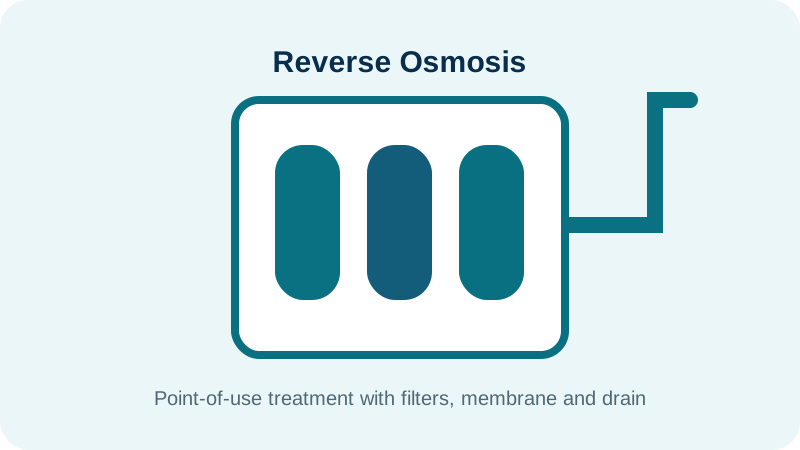
A point-of-use objective should identify the exact faucet and intended uses. When the concern involves a named substance, use current official context and determine whether a property-level sample is needed. Then review reverse-osmosis planning with the exact model, storage arrangement, drain connection, feed-water assumptions, replacement intervals, and stated purpose in view.

Do not infer that reverse osmosis is required merely because Richmond publishes PFAS information. The city’s monitoring page establishes a sampling program, not a product selection. The same proof gate applies to every other technology.

Why the current report matters more than evergreen copy

Richmond’s official water-quality and Consumer Confidence Report hubs should be revisited at decision time. A page like this can explain process, but it cannot keep a frozen report current. Annual reporting periods advance, utility operations evolve, and new notices can create temporary instructions.

Use a date-stamped evidence packet:

  1. A current bill or written utility confirmation.
  2. The newest applicable official Consumer Confidence Report.
  3. Current notices checked on the decision date.
  4. The current Richmond PFAS page if the city system and PFAS question are relevant.
  5. A property sample with date, location, method, and units when required.
  6. A written statement of the desired outcome.
  7. Exact-model and installation documents from each proposal.

If a later report replaces the report in the packet, update the screening context before making a final equipment decision. Do not treat an archived report as a permanent description of the system.

Compare written scopes, not package names

A useful proposal should answer specific questions:

  • Which utility, report, and property measurements informed the design?
  • What exact condition is each component intended to address?
  • What is the manufacturer and exact model number?
  • Which inlet conditions and service flow were assumed?
  • What plumbing, bypass, drain, electrical, faucet, and space work is included?
  • Which lines, fixtures, restoration work, or corrections are excluded?
  • What consumables and recurring maintenance are required?
  • How will the stated objective be verified?
  • What current itemized price and ongoing costs apply?
  • Which performance statements depend on operating or maintenance conditions?

This page does not publish a Richmond price range. A responsible local price requires an actual scope, equipment specification, building conditions, and a current quote. It also does not publish Richmond reviews or projects because those have not been supplied as verified evidence for this page.

Contact status and next-step limits

Before visiting the contact page, prepare the utility identity, report link, current-notice check, property history, question location, test data, and desired outcome. That preparation is useful whether the next conversation is with a utility, laboratory, plumber, equipment seller, or another qualified party.

Online request routing is inactive, and this page does not confirm Richmond territory, availability, scheduling, reviews, projects, or terms. Confirm the responsible company, qualifications, insurance, scope, and every proposal detail directly before work is scheduled.

Frequently asked questions

Does a Richmond mailing address identify the water utility?

No. A Richmond address can be associated with the city system, another public system, a district, a master-metered arrangement, or a private well. Verify the biller and exact water system before using any report.

Does Richmond use groundwater or surface water?

The City of Richmond’s official article says its surface-water plant supplements groundwater. That city-system statement does not provide a fixed blend for every address or apply to properties served by another utility.

What does Richmond’s official PFAS page say about sampling?

The city says quarterly treated-tap samples were collected over 12 months at all six treatment plants. That describes the city’s monitoring program; it is not a current kitchen-tap result for an individual property.

Do Richmond’s PFAS information or compliance tables select a treatment system?

No. Use official results as screening context only. A treatment comparison still requires exact utility resolution, the current report, a defined property-level question, appropriate measurement, and exact-model documentation.

How should I investigate hardness at a Richmond property?

Confirm the utility and measure hardness at the property with the units and sample location recorded. Do not invent a citywide value from the source description or use a mailing address to size a softener.

Can I schedule Richmond water-treatment installation through this page now?

No. Online request routing is inactive, and this prelaunch page does not confirm Richmond service territory or availability. Company, scope, qualifications, and terms require direct verification before work is scheduled.

Official sources

Online request status

Online consultation requests are not active yet.

Water Filtration Houston is accepting direct phone conversations while the online request workflow, consent language and delivery checks are completed.

Call the company directlyNo personal-information form is displayed hereThis panel does not submit a request
Call (281) 768-4021